EVENT
Young people from all over Greece met in Thessaloniki, in the framework of Thermi’s Youth Forum 2026, to discuss their role in shaping public policies. Part of the programme included a session organised by the Heinrich Böll Foundation on Youth Councils and Citizens' Assemblies, which highlighted realistic ways of strengthening participation, trust in institutions and democratic co-decision-making.

How can young people participate substantially in shaping policies that affect their lives? This question was at the core of Thermi’s Youth Forum 2026, held on September 19 and 20 at NOESIS, in the framework of the “National Youth Capital of 2026” of the Municipality of Thermi. Young people from all over the country met in Thessaloniki to exchange experiences, discuss institutions of involvement and to explore ways to strengthen young people's democratic participation.
The experiential session "Youth Councils, Citizens' Assemblies and Participation in Practice", co-organised by the Heinrich Böll Foundation, aimed to move the discussion beyond general references to participation and towards concrete tools and processes that can give young people a real say in decision-making.
Confidence crisis and new forms of participation
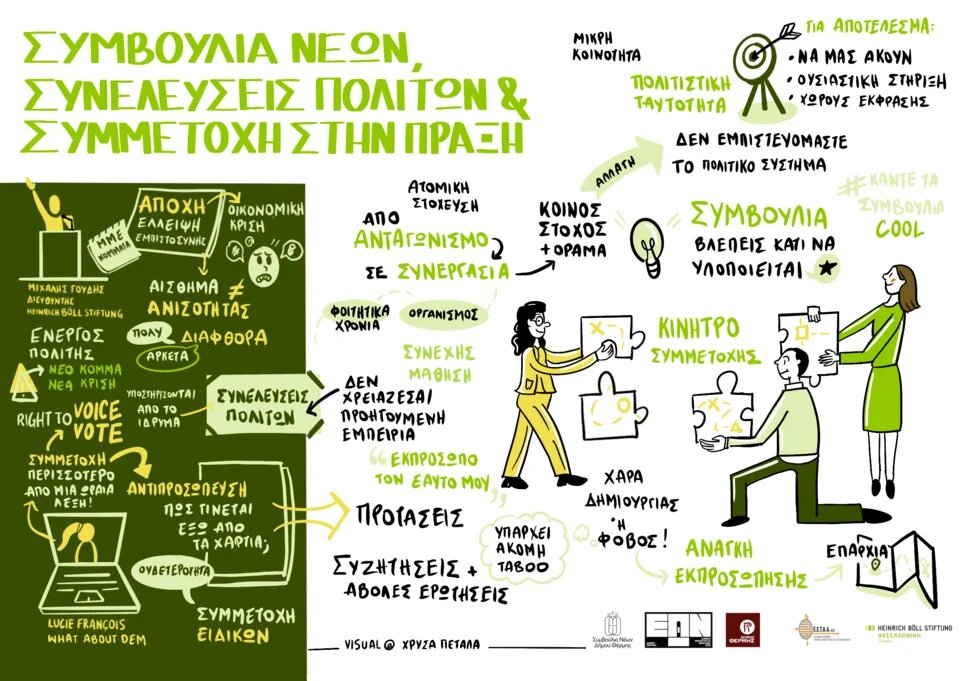
The introduction was made by the director of the Heinrich Böll Foundation – Thessaloniki Office, Michalis Goudis, who presented findings of public opinion surveys of the Foundation on political participation, trust in institutions and electoral abstention.
As he pointed out, significant parts of society show increased distrust of institutions, political parties and the media, while the continuous economic crisis reinforces feelings of inequality and frustration. Electoral abstention is not just indifference, but often expresses a deeper crisis of confidence in the political system.
In order to reverse this course, it is necessary, among other things, to put in place institutions that will allow citizens – and especially young people – to intervene substantially in public affairs. One of these tools for the democratic co-creation of public policy, which the Heinrich Böll Foundation actively supports and promotes, are Citizens' Assemblies.
This is a structured process that is marked by representativeness, deals with a specific issue and results in a number of proposals towards an authority. No previous political experience or knowledge is required for individuals who participate. They primarily represent themselves and their experiences, while through information, exchange of views and collective elaboration of proposals, they move from individual perspectives to cooperation to achieve a common goal. It is an approach that strengthens democratic education, continuous learning and collective responsibility.
From the right to vote to the right to voice
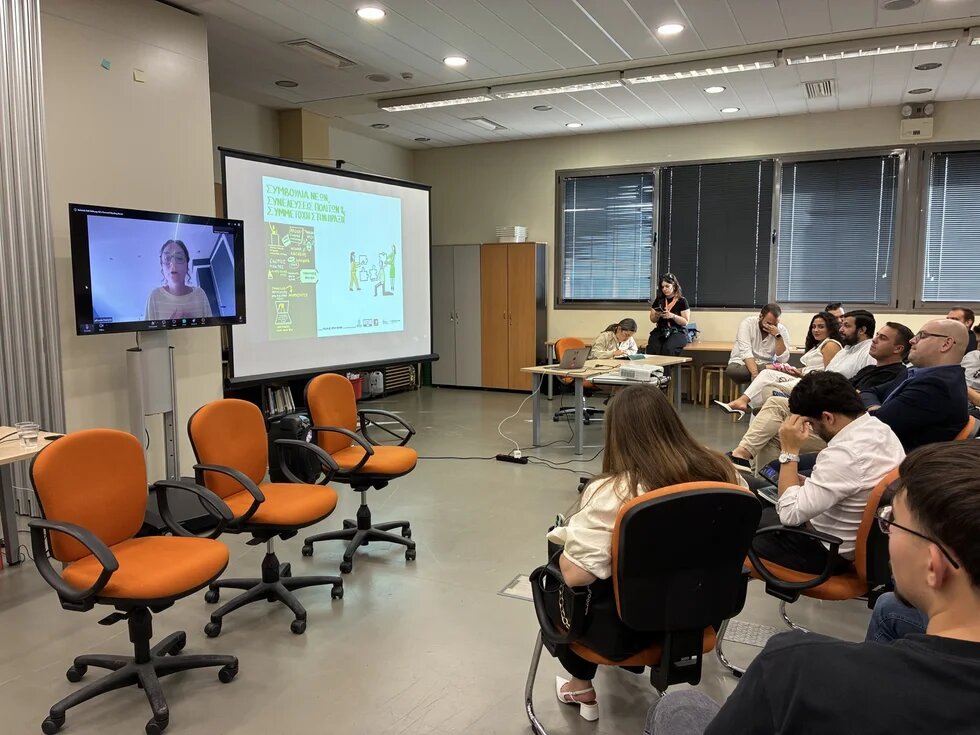
As Greece's first Citizens' Assembly is still being prepared, some empirical data was given by Lucie François from the organisation What About Dem and member of the Youth Forum of Belgium. Presenting online the experience of the first Youth Assembly in the French-speaking Belgian community, which brought together 50 young people who developed more than 20 policy recommendations, she underlined that young people have both knowledge and the willingness to contribute productively to the public debate when they are provided with the right conditions.
She highlighted the key features that make Citizens' Assemblies effective: representativeness, inclusion, evidence-based deliberation, fair process, real impact on decision-makers and complementary function to representative democracy. As she pointed out, democratic participation can no longer be limited to the electoral process. From the “right to vote” societies are called upon to shift to the “right to voice”, the right of citizens to be systematically and substantially heard between elections.
Need for visible results
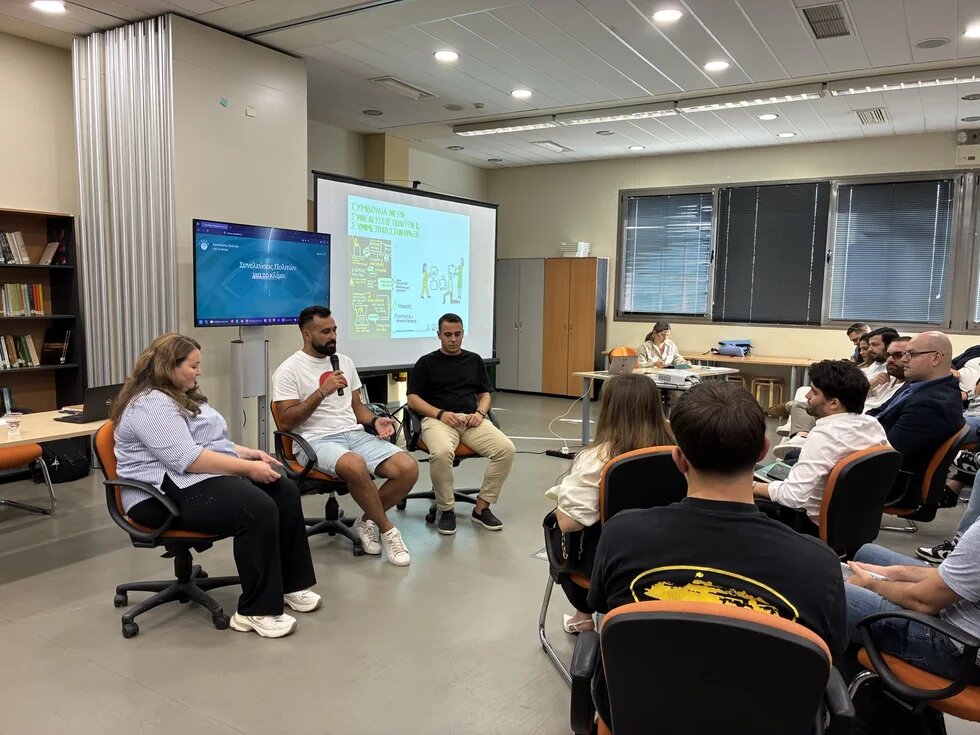
A discussion using the Fishbowl methodology followed, which allowed the participants to actively alternate in the dialogue, sharing experiences, reflections and suggestions. The discussion featured Alexandros Panagiotopoulos from Messolonghi by Locals and Asterios Filis from Demos Academy and was moderated by Olympia Datsi.
The interventions of young people highlighted the need for institutions that will not only hold an advisory function, but will bring visible results. Many participants stressed that the basic condition for staying active is to see their ideas and suggestions translated into concrete action. At the same time, issues such as the need to support Youth Councils, the enhancement of participation and consultation skills, the creation of more public spaces of expression, as well as the need to make participatory institutions more attractive and accessible to younger ages, were mentioned. The reference to the limited trust of a part of young people towards the political system was also characteristic.
The discussion demonstrated that the revitalisation of democracy depends not only on elections, but also on institutions that give citizens the opportunity to contribute directly to shaping the decisions that affect their lives. A step in this direction was taken at the Thermi’s Youth Forum 2026 and the Heinrich Böll Foundation session, where participation was presented not as a slogan, but as a practical democratic process capable of delivering tangible results.