

ARTICLE
At two international meetings in Palermo and Florence, on 21 and 24 April 2026 respectively, discussions and exchanges of experiences and stories took place – with Greek participation – centred on water as a common good and a field of democratic demands. The diverse experiences from across the Mediterranean demonstrated that water issues are directly linked to social inequalities, political conflicts and environmental crises.

Palermo: Shared concerns among Mediterranean countries
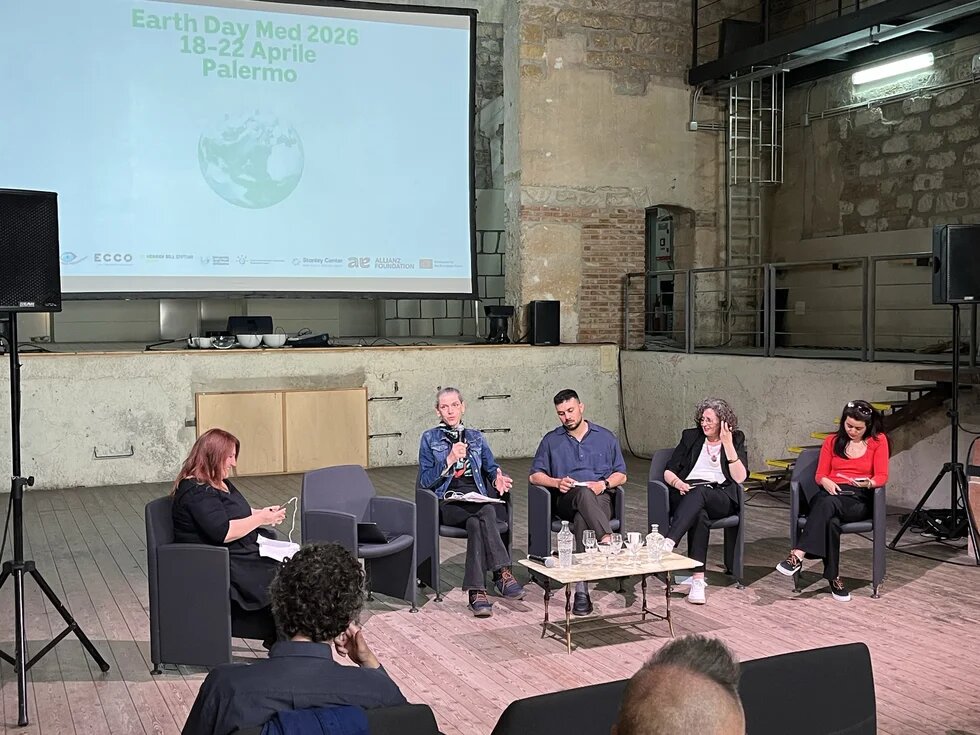
Shared concerns regarding water scarcity, water control and management, war, gender and equality issues, the climate crisis, water grabbing, intensive agriculture, drought and the commodification of water were highlighted at a workshop by researchers and experts, activists and representatives of organisations working to oppose the privatisation of water. The workshop on the Democratic Management of Water in the Mediterranean took place on 21 April 2026 at the Teatro Garibaldi in Palermo, Italy, organised by the Heinrich Böll Foundation – Paris Office and Studio Rizoma, and was held as part of the World Earth Day Festival.
Coordinated by Francesca Greco (Italy), participants included Muna Dajani from Palestine, Emna Fourati from Tunisia, Sammy Kayed from Lebanon, Ekaterini Georgiadou from Greece and Dounia Mseffer from Morocco, who highlighted the problems but also proposed strategies for the fair and equitable management of our most precious natural resource. These diverse experiences demonstrated that water issues are directly linked to social inequalities, political conflicts and environmental crises, whilst making us realise that we are much closer than we are far apart – through ecologies of adaptation, perseverance and resistance.
Control, access and quality, as well as the meanings attributed to water as a symbol of life and democracy, were some of the key points of the dialogue that were developed and shared through examples from communities and movements in the Mediterranean region.
From the water war to examples of resistance
Palestine is subjected to water apartheid by Israel, with serious consequences for the lives of its inhabitants. In a land plagued by unsustainable conditions, a water war is being waged, encompassing food and water supplies, whilst there is an inextricable link between water resources and a political reality characterised by violence. Israel’s control over water sources in Palestine is exercised in breach of international law.
In Tunisia, intensive agriculture and its enormous water requirements are having a serious negative impact on natural resources. This pressure highlights the link between various water-related problems and social and gender inequalities, as well as land management.
Water issues in Morocco are intertwined with the consequences of climate change, creating climate-related stress whilst also raising significant questions regarding political and social governance. Food insecurity and the threat to agricultural production are closely linked to water resource management.
The example of Lebanon highlighted the risks associated with public-private partnerships and investment in wastewater treatment plants, highlighting the need to move beyond purely technical solutions in a context of multiple and interlinked crises.
At the same time, forms of resistance and solidarity were presented through community-based practices, social struggles and legal challenges aimed at protecting water as a social good and safeguard its public nature, as in the case of Greece. It was also noted that structural crises relating to water issues are being exacerbated by climate change.
Following the discussion, we exchanged experiences and examples of solidarity and resistance, stories of fire and water that emerge through community practices (Tunisia), collective demands and resistance (Morocco, Palestine, Greece), legal tools (Greece), practices of reusing and redefining the collective use of water, and the expansion of collective imagination and consciousness towards alternative solutions (Lebanon).
For a detailed account of the workshop discussions, see the article: https://sbilanciamoci.info/per-una-gestione-democratica-dellacqua-nel-mediterraneo/.
|
|
|
Florence: Solidarity and connection between movements
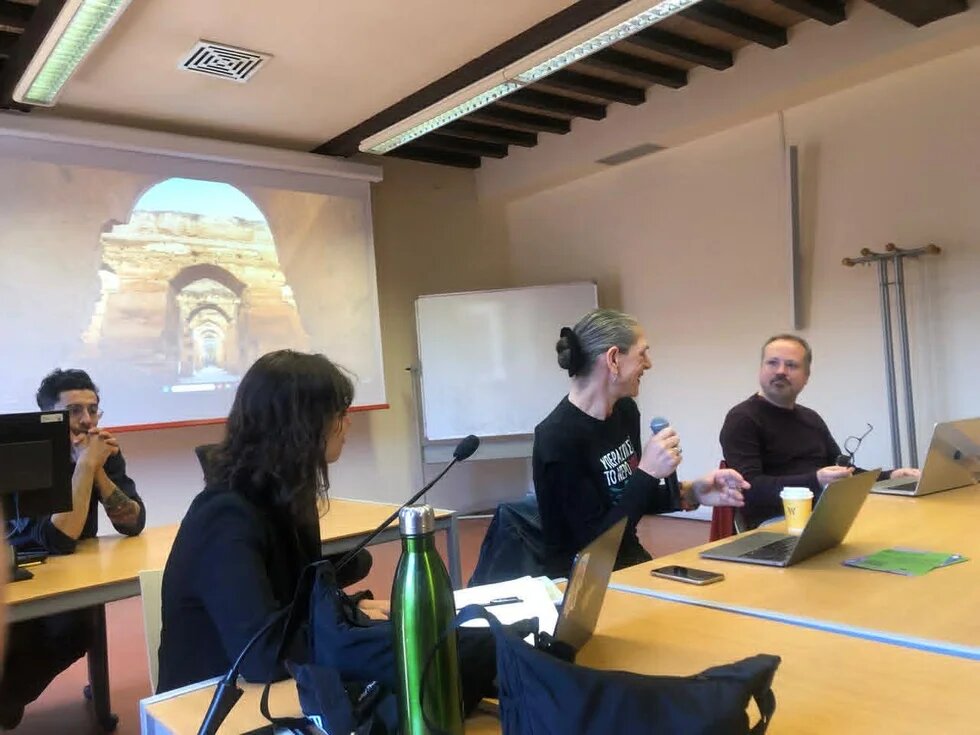
The struggles for the public nature of water in Greece and Italy, with a focus on the 2011 Italian referendum and the 2014 referendum against the privatisation of water in Thessaloniki, the current risks of commodification and the importance of solidarity networks were at the heart of the discussion held on 24 April 2026 in Florence, at the seminar organised by the Environmental Policy Working Group of the COSMOS Centre for the Study of Social Movements at the School of Social and Political Sciences of the Scuola Normale Superiore.
During the discussion, co-organised by Lydia Karazarifi and postdoctoral researcher Gemma Gasseau, with the participation of activists, lecturers and postdoctoral researchers, Ekaterini Georgiadou spoke with Tommaso Fattori, a member of Italy’s water movement and one of the driving forces behind the 2011 Italian referendum.
The discussion centred on the history and legacy of the referendum in each country, current struggles such as the recent referendum in Empoli, Tuscany, and the legal battle against the Joint Ministerial Decision on water pricing, as well as other forms of indirect privatisation. Solidarity and the links between movements at local and transnational levels are evident in the connections between the struggles in Thessaloniki and Florence and the interaction of the networks that have developed.
Some common themes included questions about democracy, defence strategies and solidarity networks. One point that emerged from the discussion was the ongoing threats to water resources, which appeared to be escalating, and the need for collective responses to defend them. The social dimensions of managing issues such as overtourism and climate change emerged as key points that heighten our focus on creating collective forms of resistance and relationships of solidarity, which in turn generate strength, a fighting spirit, experience and friendship.
‘We write water, but we read democracy’
As the Palestinian representative in Palermo had noted, ‘everyone has a role to play in oppressive regimes’, and these meetings and bonds of solidarity offer hope for a different present and future, because ‘we write water, but we read democracy’.
With a view to linking interdisciplinary research and the experience of social movements in their demands, with the aim of formulating strategies to address contemporary challenges relating to ‘water justice’, such meetings and actions are a valuable tool and a starting point for further interaction and collaboration.
As we wrapped up the trip, we reflected on and recorded the places where we did or did not find public taps and free water, and reflected on how the commodification of water is perpetuated through its enforced supply in plastic bottles. Collective action and campaigning for public taps and free water accessible to everyone has much to offer in establishing a social consciousness that water is not, and cannot be, a commercial product.