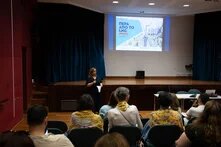
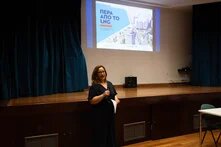
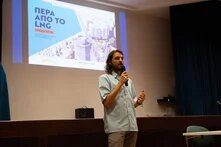
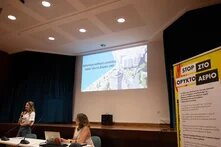
During a period of global geopolitical realignments in the energy sector, local communities are demanding a greater say in decisions that affect their environment, health, and safety. The planned LNG terminal in the Thermaic Gulf, about which public information remains limited, has sparked concerns and public opposition. The event “Beyond LNG” (8 and 9 July 2026) sought not only to shed light on the different dimensions of the issue, but also to explore ways of fostering collective action in the period ahead.

The discussion surrounding the planned floating storage and regasification unit (FSRU) for liquefied natural gas in the Thermaic Gulf has so far remained largely absent from the public discourse in Thessaloniki. Although this project is located a short distance from the urban centre and from protected areas of the gulf, a Greenpeace survey showed that only a small minority of citizens were aware of the plan.
With this in mind, Greenpeace Greece, the Heinrich Böll Foundation, and the Goethe-Institut Thessaloniki organised a two-day event on July 8 and 9, 2026, titled “Beyond LNG: A Hackathon for Thessaloniki’s energy future.” As the event’s title suggests, the goal of this ideas competition (hackathon) was not merely to identify problems, but to generate concrete proposals and explore ways to mobilise the city’s community.
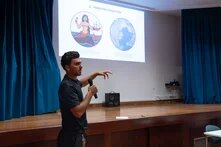
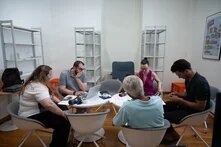
The first day featured a closed-door workshop attended by scientists, engineers, representatives of various organizations, members of environmental groups, journalists, students, and active citizens. The session began with a scientific presentation by Yannis Krestenitis, Professor Emeritus of Coastal Engineering and Oceanography at Aristotle University of Thessaloniki, who outlined the potential impacts of such a facility on the Thermaic Gulf.
According to the presentation, the terminal is planned to be located a few kilometres from the urban complex and will include two permanently moored ships that will occupy an area of approximately 7.5–8 hectares. Particular emphasis was placed on the impacts of the LNG regasification process, during which large quantities of seawater are used; this water is returned to the marine environment containing chemical contaminants and at a significantly lower temperature. The impacts on marine biodiversity, potential methane emissions, air pollution, and the risks associated with a possible accident were also highlighted.
However, the focus of the two-day event was not limited to scientific documentation. The participants were divided into three working groups focusing on: a) environmental impacts and quality of life, b) communication and public awareness, c) energy needs and alternative solutions. Through a structured collaborative process, they were asked to address the event’s central question: why the city should invest in new natural gas infrastructure instead of initiatives that directly improve residents’ quality of life.

The focus on civic movements
The experience of the Pagasetic Gulf served as a constant point of reference in the discussions. Napoleon Kolovos, president of the Association for the Protection and Promotion of the Pagasetic Gulf “The Pagasetic Gulf unites us,” shared the experience of a struggle that lasted about five years and ultimately led to the rejection of the Environmental Impact Study for a similar project in Volos.
According to his account, a crucial factor was the formation of a broad social coalition. Scientific institutions, professional associations, environmental organizations, municipal authorities, and citizens managed to form a united front, built around raising awareness and highlighting the project’s potential impacts. The creation of a vibrant community on social media, public rallies, and the issue’s constant presence in the local community proved to be key elements of the campaign.
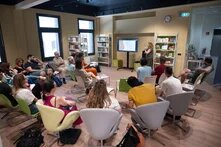
This message also resonated in Thessaloniki. At the public event on July 9, where the results of the hackathon were presented, it became clear that the issue is viewed not only as an environmental and energy issue, but also as a matter of democratic participation. How are decisions made regarding projects that directly affect the daily life of an entire city? How well-informed are local communities? And what, ultimately, is the role of citizens in shaping their energy future?
The same perspective was highlighted in the remarks by Gianna Tsokou, a theater scholar with a strong presence in Thessaloniki’s social movements, who linked the discussion on LNG to previous protests in the city, from the referendum on water to initiatives to protect the antiquities on Venizelos Street and the metropolitan park at the Thessaloniki International Fair. A common thread running through all these experiences was that long-term social struggles are not defined solely by their immediate outcomes, but rather create networks, experience, public discourse, and social awareness—elements that are essential for any new struggle.
Winning proposal and next steps
The outcome of the entire process was the selection of the “Learn – Navigate – Guard” proposal as the winner—an initiative focused on informing and mobilizing citizens regarding the environmental and social impacts of LNG in the Thermaic Gulf. Under the slogan “Better clean air than a floating LNG bomb,” the group proposed an action plan that includes systematically documenting the project’s risks, creating a citizens’ network, utilizing social media, and organizing open informational events for the general public.
The award comes with a modest financial support to help take the first steps. However, as was pointed out, the essence lies not in the award itself but in the momentum the initiative may generate. Plans are already in place for the team to continue meeting, with the goal of refining the action plan, producing well-researched informational materials, and expanding the network of participants.
At the same time, the other groups were encouraged to continue refining their proposals, exploring synergies and joint actions. The intention expressed at the end of the two-day event is not for the ideas to remain merely at the level of presentations, but to be transformed into concrete initiatives for civic action.
In a city where the plans for the LNG terminal remain unclear and information is limited, the event “Beyond LNG” sought not only to inform, but also to lay the groundwork for organised, evidence-based, and long-term civic engagement. And as the experience of the Pagasetic Gulf shows, the outcome of such cases depends to a large extent on whether local communities decide to take an active role in decisions that affect their future.
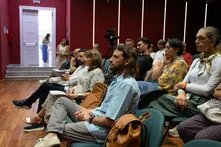
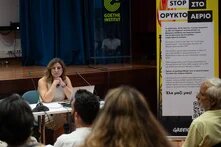
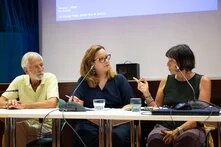
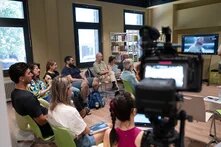
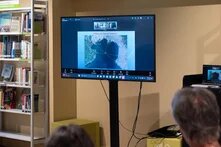
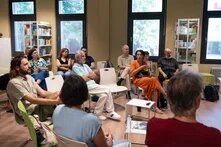
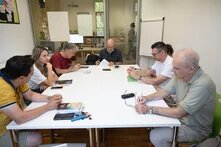
Στιγμιότυπα από τη δεύτερη μέρα της εκδήλωσης στο Goethe-Institut Thessaloniki / Snapshots from the second day of the event at the Goethe-Institut Thessaloniki.
Image credits