Migration

Here you will find all audio and video content on the topic. Click the button to access our written articles and more extensive publications.

articles and publications
Description

Aisha presented the asylum authorities with two absolute grounds for protection – a serious illness with no available treatment in her country of origin, and genital mutilation. Yet, she was rejected. 

“Aisha, A system deaf to gender violence” is part of the series “Lost in a legal maze: 10+1 stories of asylum seekers in Europe”. This video series explores – perhaps for the first time – the legal difficulties and the legal pitfalls faced by asylum seekers in Greece and Europe, within a legal system designed to fail them. Eleven people at different stages of the asylum procedure talk to the camera about their own cases, revealing with their testimonies the lack of coherence in asylum policy, the high degree of arbitrariness and a systematic attempt to discourage them.

Produced by Heinrich Böll Stiftung – Thessaloniki Office, in collaboration with Equal Legal Aid and directed by Sideris Nanoudis of HomoLudens Productions.

First screening: 13 May 2024, Thessaloniki, Greece

Description


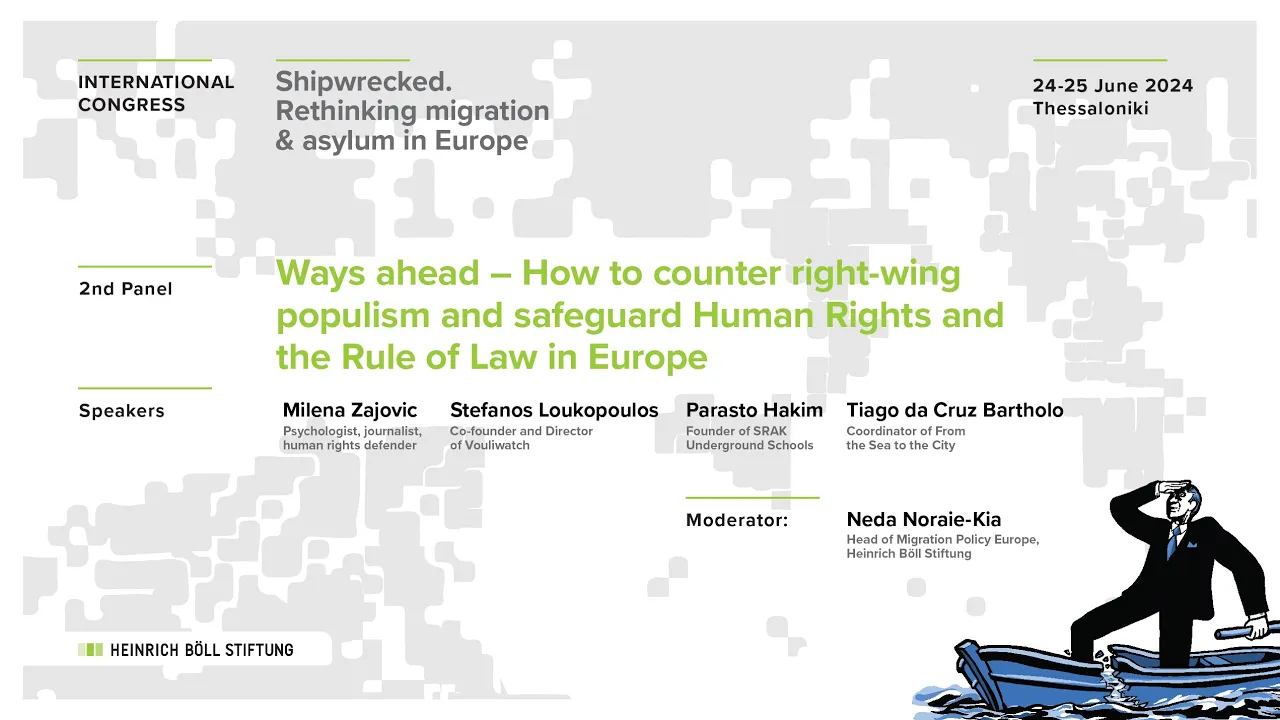
Ways ahead – How to counter right-wing populism and safeguard Human Rights and the Rule of Law in Europe

How can refugees and migrants themselves and civil society in general actively counter the shift to the right? In how far can journalism and media play a role to change the mainstream narratives and stereotypical perceptions? What are legal ways to challenge breaches of Rule of Law and what is the potential of strategic litigation? How can municipalities and the local level despite national and EU level policies support and welcome people on the move?


Milena Zajovic, psychologist, journalist, human rights defender: “After we connected actors on the ground [through ‘Are you Syrious?’ platform], we created through BVMN an advocacy platform that really tried to bring information from the ground to policy makers, to shortcut the entire big NGO monopoly. […]  I think our goal needs to be to become redundant because we need to constantly reinvent what we are doing and to do it from the scratch, in order to stay relevant”.


Tiago da Cruz Bartholo, coordinator of From the Sea to the City: “From the Sea to the City is aiming at turning a transnational local authority network into a political actor. For example, we have managed to take 10 municipalities last year to Brussels. And they were heard. It didn’t have the outcome of them being incorporated as an EU body to have direct exchange for policymaking, which is ideally what we would aim for, but it was for sure a valid step which we will continue to work on”.


Stefanos Loukopoulos, co-founder and director of Vouliwatch: “Firstly, we decided to be pop, […] we are trying to wrap something that might be a bit ugly and boring with colorful thing to make it more attractive. […] Secondly, we are trying to find clever ways to connect abstract terms that we are advocating for to practical issues. Thirdly, fighting – by fighting you set an example that you can stand up to seemingly authorities, entities and institutions that are bigger than you”.


Parasto Hakim, founder of SRAK Underground Schools: “I’m working on secret schools in Afghanistan from 2021 in September, shortly after the Taliban came. We have more than a thousand girls right now on our platforms that they are studying with us in secret schools and we have made some small businesses for them, so that they can support themselves and their families to escape being forced for marriages”.
Description


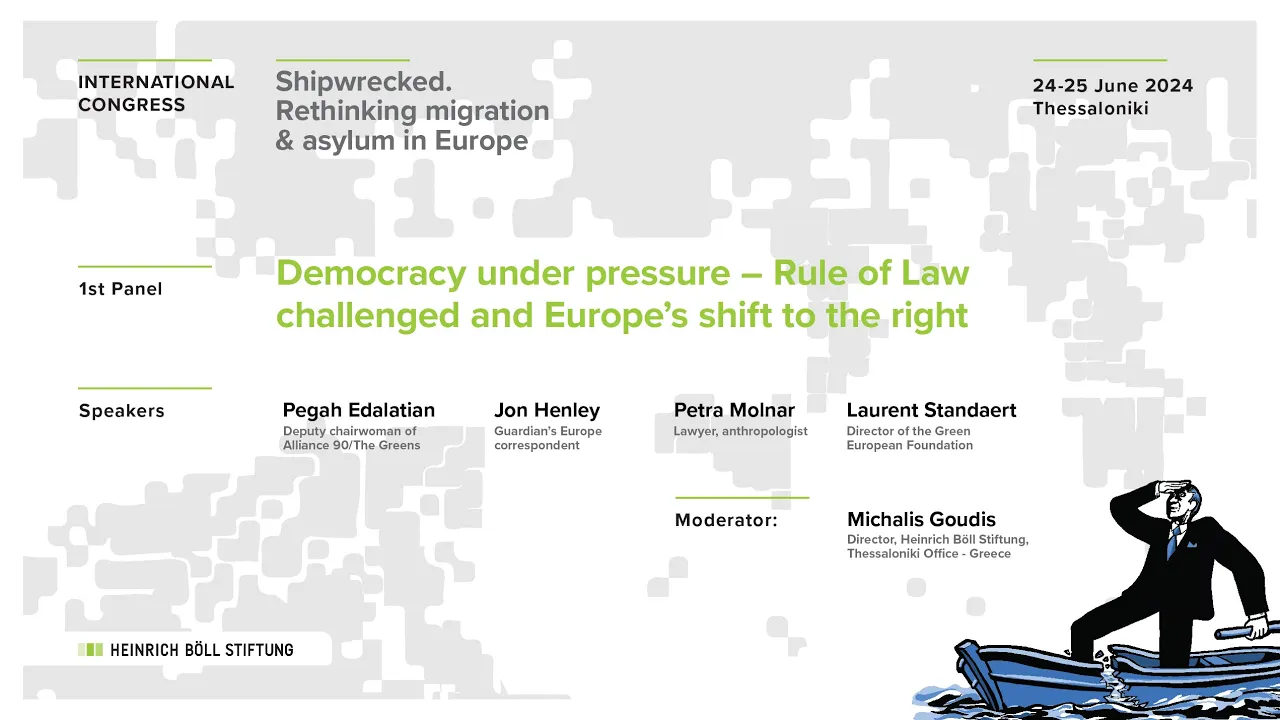
Democracy under pressure – Rule of Law challenged and Europe’s shift to the right

How have the discourse and actual policies regarding migration shifted in the last years in Europe? In how far is this part of an overall shift to the right? What role do fake news and disinformation, especially since the pandemic and the war against Ukraine play a role? How can the latest EU election results be interpreted and dealt with?


Petra Molnar, lawyer and anthropologist: “I’ve spent the last six years or so trying to understand how migration is changing through the use of new technologies – that includes surveillance, different types of algorithms, visa triaging and anything in between that is impacting the way that people on the move are experiencing their journeys and how power also operates in society. […] There are people who are at the center of this technological experimentation, which is unregulated, high-risk and harmful”.


Jon Henley, Guardian’s Europe correspondent: “The absolute core ideology that ultimately defines all of Europe’s far-right parties is nativism – the belief that the native group (whatever that may be) should be the exclusive inhabitants of the native state and then anybody who comes from outside the native group, any nonnative elements, represent some kind of threat. And that obviously explains why immigration is their huge battle cry and always has been and always will be”.


Pegah Edalatian, deputy chairwoman of Alliance 90/The Greens: “In Germany we got in a lot of refugees and there was so much solidarity and sympathy and they turned it around… You know there were some real problems but the far-right and the conservatives constantly focused on chaos, on fear, and they repeated that and repeated that until the whole society’s attitude turned around towards it. So that’s also important, how right-wing people play with the emotions of people”.


Laurent Standaert, director of the Green European Foundation: “[The new European Parliament] is not a far-right European Parliament, but when you have Ursula von der Leyen coming on the stage after and saying ‘The center holds’ […] it is obviously completely fallacious. No, the center doesn’t hold, it has entirely shifted to the right. The decline of the progressives is now confirmed in ways that are more structural than even in the past and that’s the scary part”.

Description

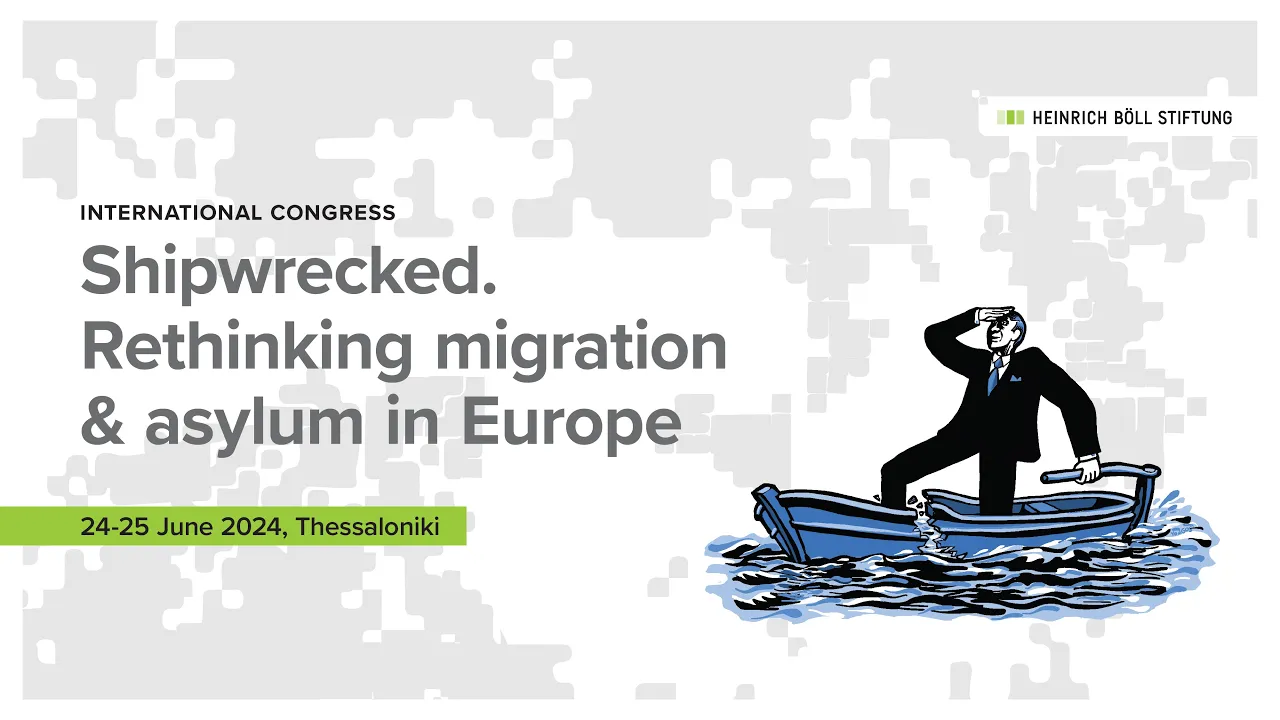
The complex topic of migration and asylum was examined at the international conference "Shipwrecked. Rethinking migration and asylum in Europe", organised on 24-25 June 2024 in Thessaloniki, Greece by the Heinrich Böll Foundation. Over 130 experts from all over the world – activists, lawyers, journalists, academics, politicians, members of civil society organisations – spent two days discussing and analysing the current situation and the perspectives that lie ahead. They took part in a busy programme of workshops, open conference and networking meetings exploring different aspects of the issue, from the criminalisation of people on the move to border violence and from the LGBTQI+ asylum seekers to the role of local government. In a Europe shaken by the rise of the far right and adopting ever stricter pacts on migration and asylum, what can the resilience of the Rule of Law be? The programme of the congress was accompanied by events such as the photo exhibition "1000 dreams: stories from the LGBTQ+ refugee experience", and the open-air concert with singer Vasso Vassiliadou and her musicians, which turned into a big folk party with the participation of people from the neighbourhood.

Description

Our partner organization Border Violence Monitoring Network recently hosted a webinar titled 'Understanding the Pact: How the EU is Abolishing the Right to Asylum', which we were happy to support. In light of the complexity and intransparency of the reform process, this webinar not only provided much needed elaborations on the proposed changes to the Common European Asylum System, but also the potential implications these would have in different EU Member States. Given the pressure under which the current trilogue negotiations are held, in order to reach an agreement between the co-legislators, namely the Commission, the Council, and the Parliament, before Christmas, this webinar is a timely intervention to unpack the migration pact. Thanks to great speakers from Refugee Support Aegean, Association for Juridical Studies on Immigration (ASGI), the University of Keele and the Helsinki Foundation for Human Rights, who all are very experienced with regard to their respective context the webinar sheds light on the pact and its main regulations (Screening, Asylum Procedures, and the topic of ‘instrumentalisation’) and how their implementation would look like, given the realities in Greece, Italy, Turkey and Poland. Watch the webinar recording with links to the audio of live translations into Arabic, Turkish and BCS. Additionally, the Border Violence Monitoring Network published a short summary of the discussions in Arabic, Bulgarian, BCS , Farsi, French, Greek, Polish, Spanish and Turkish, on their website, here.

How the media covers migration in Bosnia-Herzegovina and Croatia - Heinrich Boell Foundation - Office Thessaloniki

video-thumbnail Watch on YouTube
Description

A crucial factor in shaping public narratives and opinions on refugees and migrants is the media. In order to better understand public perceptions and discourses along the so-called Balkan route, we commissioned three studies looking into the language and visuals used to report about migration and people on the move in different countries, namely Turkey, Greece, Bosnia and Herzegovina, Croatia.

Based on these three e-papers we created three short videos that summarise the main findings of each study. This one is the video for Bosnia-Herzegovina and Croatia.

You can also watch:

The video for Turkey: https://youtu.be/fVd-EHGhzJc

The video for Greece: https://youtu.be/nzVnQ2ywQXg

A compilation of all three aforementioned videos: https://youtu.be/75QEmaOKM0Q

How the media covers migration in Greece - Heinrich Boell Foundation - Office Thessaloniki

video-thumbnail Watch on YouTube
Description

A crucial factor in shaping public narratives and opinions on refugees and migrants is the media. In order to better understand public perceptions and discourses along the so-called Balkan route, we commissioned three studies looking into the language and visuals used to report about migration and people on the move in different countries, namely Turkey, Greece, Bosnia and Herzegovina, Croatia.

Based on these three e-papers we created three short videos that summarise the main findings of each study. This one is the video for Greece.

You can also watch:

The video for Bosnia-Herzegovina and Croatia: https://youtu.be/sFASUoRWsA4

The video for Turkey: https://youtu.be/fVd-EHGhzJc

A compilation of all three aforementioned videos: https://youtu.be/75QEmaOKM0Q