
CONFERENCE
Who decides which technologies shape our daily lives? What institutional and technical safeguards protect personal data and democracy when critical functions of the state, healthcare, and information systems depend on a handful of multinational giants? These questions were at the heart of the conference “Brave Digital World: Questions about the new reality,” organized by the Heinrich Böll Foundation in cooperation with Goethe-Institut Athen on Friday, 13 November 2026.

On the very day of the event, a major global outage affecting Microsoft’s infrastructure disrupted public services, hospitals, and communications in more than 70 countries. As Michalis Goudis, Director of the Heinrich Böll Foundation - Thessaloniki Office, noted in his opening remarks, the incident served as a timely reminder of the need to examine “what it ultimately means for our democracy to be so heavily dependent on large technology companies.”
Greece: Beyond the success story of digitalization
The rapid digital transformation of the Greek public sector following the pandemic simplified everyday interactions with the state and fundamentally reshaped the relationship between citizens and public administration. Yet, as a Solomon investigation presented during the conference’s first panel discussion revealed, the convenience of digital services masks significant shortcomings in transparency and institutional oversight, as well as questions of strategic autonomy in the management of sensitive data and public procurement. The discussion, moderated by journalist Nektaria Stamouli, highlighted concerns raised in the investigation.
“Today, the vast majority of critical government information systems are hosted not on public infrastructure, but on Microsoft’s Azure cloud,” said Solomon journalist Danai Maragoudaki. She emphasized that when millions of medical records and tax files are involved, “the issue ceases to be an individual one and becomes a collective democratic concern.”
“We log into Gov.gr to obtain certificates, visit pharmacies with electronic prescriptions, and pay our taxes. In all these interactions, we provide our social security number, our identity details, and information about the medications we take. Our health and tax records are not just a collection of numbers. They are the digital representation of our private selves. And when such data is exposed, it is not like a leaked password that can simply be changed.” Danai Maragoudaki, Solomon journalist
According to the investigation, as more government systems were migrated to the cloud, the state’s contract with Microsoft was repeatedly expanded through successive amendments rather than through new open tenders. As a result, the total cost increased by 50%, from €87 million to €131 million, without giving the government the opportunity to compare alternative solutions or secure more competitive pricing.
At the same time, although Greece’s Digital Governance Law (Law 4727/2020) required data-classification studies to assess the sensitivity of government data and determine the necessary security measures before storage, “the process was reversed in Greece.” The data were transferred to the cloud first, while the relevant studies were commissioned only in the summer of 2026, at a cost of €9.5 million. Following delays, the project was removed from the Recovery and Resilience Facility and transferred to national funding sources.

For Thodoros Karounos, researcher with NTUA’s Infostrag Group and board member of the Open Technologies Alliance (GFOSS), the problem is not public-private cooperation itself. Rather, it is the fact that the Greek state enters negotiations “as a poor relative,” lacking both in-house expertise and the capacity to negotiate on equal terms.
While open-source software accounts for 70%-80% of supporting infrastructure worldwide, Greece has systematically adopted proprietary solutions from companies such as Microsoft and Oracle, even in institutions that had already developed open-source alternatives, such as the Council of State.
Moreover, these contracts were signed without exit clauses, creating a state of technological lock-in in which “the public sector is obliged to pay rent indefinitely” for software licenses and infrastructure, while the cost of migrating data to another provider becomes prohibitively high.
“The original Gov.gr cost around €5 million and could have been expanded with an additional €5-10 million. Instead, the Ministry chose a solution costing ten to fifteen times more, with 30%-40% of the total amount going solely to Microsoft licensing fees.” Thodoros Karounos, GFOSS Board Member
Karounos recalled that fifteen years ago Greece had a strong research ecosystem centred around universities and GRNET, which developed the open-source cloud platform Synnefo, “technically on par with Azure when it was launched,” as he noted, and also laid the foundations for Gov.gr. Instead of building on these public infrastructures, however, policymakers opted for commercial solutions that cost many times more, while gradually hollowing out the university ecosystem that had once trained engineers capable of designing and building systems of their own. In their place, he argued, professionals increasingly became administrators of off-the-shelf software packages.

Beyond technical and economic dependence, hosting state records with U.S.-based providers also creates legal vulnerabilities. As Lefteris Chelioudakis, Executive Director of Homo Digitalis, explained, U.S. legislation such as FISA and the CLOUD Act enables American authorities to request access to data even when the physical servers are located within the European Union.
“The fact that I have a Microsoft cloud server in Greece, Ireland, or Berlin does not mean that the company could not receive an order tomorrow requiring it to share data with the U.S. government.” Lefteris Chelioudakis, Executive Director of Homo Digitalis
Chelioudakis also pointed to the systematic circumvention of European data-protection rules within Greece. A Europe-wide investigation by the European Data Protection Board (EDPB) found that, among seven critical public-sector bodies examined across government ministries, only one had carried out a Data Protection Impact Assessment (DPIA), the preliminary study required to identify potential risks to citizens’ sensitive data and determine the safeguards needed to mitigate them.
It is also worth noting that although the organizers had formally invited both the Ministry of Digital Governance and the competent Secretary General to participate in the discussion, neither responded to the invitation.

European Union: Prerequisites for genuine digital sovereignty
With 70%-80% of Europe’s cloud market and critical digital infrastructure controlled by non-European providers, the European Union is increasingly seeking ways to achieve greater technological autonomy. But is replacing American tech giants with European companies enough? This question was the focus of the conference’s second panel discussion, moderated by Drew Mitnick, Director of Digital Policy at the Heinrich Böll Foundation’s Washington Office.

Marcel Kolaja, Policy and Advocacy Director for Europe at Access Now and former Vice-President of the European Parliament, warned that the European Commission’s proposed Cloud and AI Development Act (CADA), which aims to triple data-centre capacity in the coming years, could ultimately produce the opposite of its intended effect. Since most data centres are owned or leased by the same American technology giants, increasing capacity may further consolidate their market power rather than decentralize it.
Questioning the very concept of “technological sovereignty,” Kolaja proposed the alternative notion of digital self-determination, arguing that European policy should place human rights, rather than purely industrial interests, at its core. As he noted, replacing one foreign provider with a European one does not automatically guarantee respect for fundamental rights.
“The real question we should ask ourselves is whether we truly want to live in a society that places so much emphasis on surveillance rather than protection.” Marcel Kolaja, Policy and Advocacy Director for Europe, Access Now

Katharine Jarmul, founder of Kjamistan and author of Practical Data Privacy, challenged the narrative that Europe is somehow “falling behind,” noting that “if being ahead means elections being won or lost by billionaires, then I am perfectly happy to stay behind.”
As she pointed out, leading research laboratories in cities such as Zurich and Warsaw are staffed by European scientists, yet their talent is continually drawn toward heavily funded American companies, reinforcing the creation of monopolies. She also called for challenging the assumption that cloud infrastructure must operate exclusively according to models designed by Big Tech, advocating instead for privacy-first technologies.
“Open source is inherently a collective good. But when some of the largest open-source projects in the world are controlled by a handful of U.S. corporations and depend on whether Google decides to contribute $50,000 next year, then they can no longer truly be considered collective goods.” Katharine Jarmul, Founder of Kjamistan
She described plans for the construction of gigantic data centres as energetically unfeasible for Europe’s electricity grids and highlighted a number of viable decentralized alternatives, ranging from the migration of public administrations to open-source software, as already taking place in the German state of Schleswig-Holstein, to the interconnection of Germany’s existing public high-performance computing (HPC) clusters for the training of collectively developed AI models, which together possess more computing power than the entire infrastructure of Elon Musk’s companies combined.

Konstantinos Komaitis, Senior Resident Fellow at the Atlantic Council’s Democracy + Tech Initiative, cited three recent developments that demonstrate the urgency of the debate: Microsoft’s global outage, which left government services in Australia and Singapore without communications and disrupted ambulance GPS systems in the United Kingdom; the Trump administration’s 2026 directive instructing U.S. embassies to lobby Brussels and foreign governments against the GDPR; and U.S. export controls that have restricted access to advanced AI models for non-U.S. citizens.
He emphasized that no country or continent can independently produce every layer of the technological stack, from semiconductors and cloud infrastructure to undersea cables and software. The answer, therefore, lies neither in technological isolation nor in simply replacing American providers with European ones, but in returning to the foundational principles of the internet through interoperable sovereignty: an architecture that gives both governments and citizens the freedom to switch providers and move their data.
“Sovereignty should be a property of network architecture, not merely a property of ownership. If we simply replace American monopolies with closed European ones, we change the flag, but not the nature of the problem.” Konstantinos Komaitis, Senior Resident Fellow, Democracy + Tech Initiative, Atlantic Council

Privacy in the age of digital surveillance
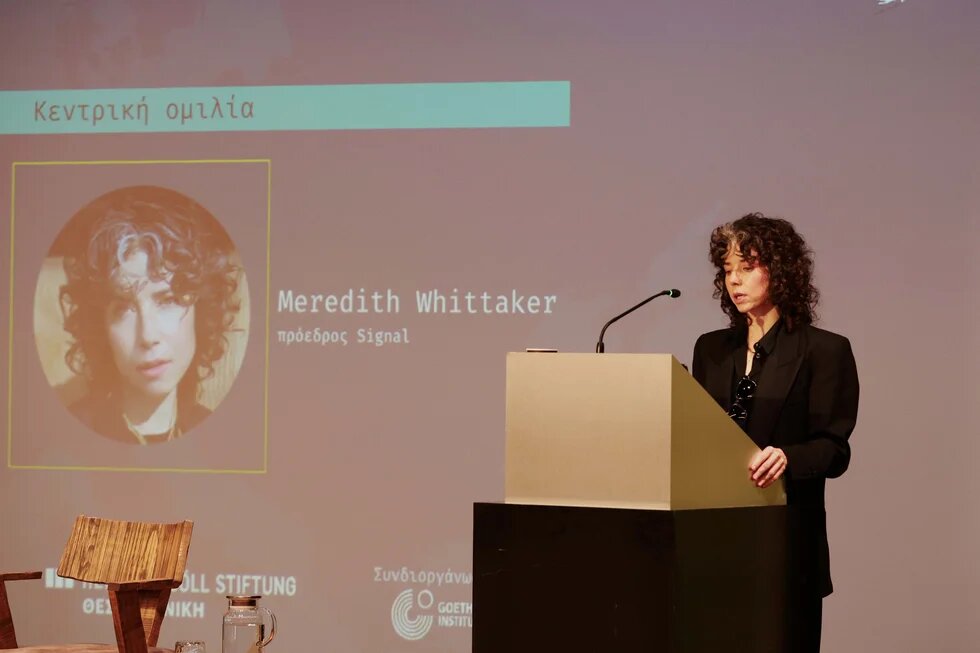
The highlight of the conference was the keynote address delivered by Meredith Whittaker, President of the non-profit encrypted messaging service Signal, followed by a discussion with Jan Philipp Albrecht, Co-President of the Heinrich Böll Foundation.

Meredith Whittaker, who spent thirteen years at Google before leaving the company after leading opposition to its involvement in the military AI programme Project Maven and later co-founding the AI Now Institute, opened her remarks with a reference to the kleroterion, the ancient Athenian device used for the random selection of jurors. As she explained, the Athenians “did not rely on good intentions, promises, or charismatic leadership. They built a machine that made interference difficult, perhaps impossible. They embedded their politics into the design itself so that trust in benevolent leaders became unnecessary.” According to Whittaker, the same principle lies at the heart of Signal’s design.
“We do not promise that we won’t read your messages; we build Signal so that we literally cannot read them. Even if you put a gun to my head, I could not hand over users’ data.” Meredith Whittaker, President of Signal
While acknowledging that Signal still relies in part on Amazon Web Services infrastructure, Whittaker stressed that “end-to-end encryption ensures that neither Amazon nor Signal itself can access users’ messages. It allows us to use these companies’ infrastructure like a road, without handing over the cargo to them.”
Drawing on examples from the Greek context as well, including the 2020 contract with Palantir, the leak of overseas voters’ email addresses from the Ministry of the Interior, the “Kentavros” and “Hyperion” biometric surveillance systems deployed on the Aegean islands, for which the Hellenic Data Protection Authority imposed a €175,000 fine, or, as she remarked wryly, “about what Google spends on juice in a single day”, as well as the conviction of four Intellexa executives in February 2026 in connection with the Predator scandal, she stressed that the Greek experience “offers lessons that the rest of Europe needs to learn.”
“A surveillance business model with a European address is still a surveillance business model.” Meredith Whittaker, President of Signal
Whittaker pointed to three developments that pose a threat to privacy. The first is Chat Control, a legislative proposal that has been under discussion since 2022 with the stated aim of tackling child sexual abuse, but which would effectively mandate the mass scanning of private communications on users’ devices. “A backdoor in encryption has no nationality,” she warned. “Once it exists, it exists for every intelligence service and every criminal organization in the world.” She further reiterated unequivocally that if Signal is required to undermine its encryption, it will withdraw from the European market.
She described mandatory age verification as equally concerning in the context of proposals to ban children under 15 from using social media. She warned that “age verification for children is, in practice, age verification for all of us, and it very quickly slides into identity verification and the monitoring of where you go and what you do online.”

She identified AI agents as the “most dangerous” development and the one that, by her own admission, worries her more than any other. As these agents are increasingly being integrated directly into mobile operating systems, they gain access to users’ screens, contacts and messages before the latter are encrypted. Architecturally, she argued, they operate in much the same way as spyware such as Predator.
“The difference between spyware that reads your screen and an agent that reads your screen on your behalf comes down to a constructed notion of consent and intent. Architecturally and technically, they are exactly the same thing.” Meredith Whittaker, President of Signal
Presenting seven concrete policy recommendations, she called for the permanent closure of any pathway to the scanning of private communications; for public-sector digital contracts to be treated as a matter of governance, requiring publication, impact assessments and exit strategies, with no “free” agreements outside official procurement frameworks; for open-source software and non-profit infrastructure to be funded as public goods; for the GDPR not to be sacrificed in the name of “simplification” but enforced in practice; for the underlying business model to be regulated rather than users’ anonymity being dismantled; for accountability in the Predator scandal to be pursued all the way to those ultimately responsible; and for a clear right to opt out of operating-system AI agents to be legally guaranteed.
“Regulate the business model, not the user. Protect anonymity as democratic infrastructure.” Meredith Whittaker, President of Signal

During the discussion that followed, Jan Philipp Albrecht – former Member of the European Parliament, lead negotiator for the GDPR on behalf of the European Parliament, and former Minister for Digital Affairs in the German state of Schleswig-Holstein – raised the question of how citizens can once again be mobilized in defence of privacy after years of being told that data protection is no longer relevant because “we already share everything about our lives online.” Whittaker argued that public attitudes are shifting rapidly as people increasingly experience the real-world consequences of algorithmic systems, from being denied loans and subjected to workplace surveillance to living under systems of mass monitoring and bearing the environmental costs of ever-expanding data centres.
Turning to the legal tools available to Europe for addressing the advertising-driven business models of Big Tech, Albrecht emphasized that digital platforms cannot be considered neutral intermediaries, since their algorithms actively shape and curate the content users see.
“These platforms do not simply carry content from one user to another. They use algorithms to curate what is published and what is shown to users. This stands in direct contradiction to the liability protections from which they benefit.” Jan Philipp Albrecht, Co-President, Heinrich Böll Foundation

Warning of a potential investment bubble in artificial intelligence, Whittaker urged Europe to abandon the ambition of creating European replicas of the American technology giants. Instead, she argued, investment should be directed towards smaller, more efficient, and more accountable AI systems designed to address specific real-world needs, whether in hospitals, factories, or other public-interest applications, while operating under strict privacy and security safeguards.
“Most of what we are experiencing today is not actually new. The concentration of power, surveillance-based business models, and the temptation to use monitoring as a means of consolidating power are all very old phenomena. What we build next, however, does not have to follow the same path. That part is still ours to decide.” Meredith Whittaker, President of Signal