

ARTICLE
As a Green Foreign Policy Fellow of the Heinrich Böll Foundation Thessaloniki in 2025–2026, Panagiotis Moumtsakis looks deeper into one of the elements of the green foreign & security policy narrative, the elements of interventionism. He aims to develop an Intervention Ladder to better describe the specific requirements applied when moving from soft to increasingly stringent measures. A policy tool with legal, ethical, and political criteria structuring each step, enabling faster and better‑justified decisions in moments of crisis.

Abstract
Throughout the years, strong normative elements, such as peacebuilding, cooperation, promotion of human rights, and environmental justice have been the very foundations of Green and progressive foreign policy in general. Yet as new crises unfold and we gradually enter an era of permacrisis, decisions about sanctions, diplomatic isolation, or forms of defensive support often become more relevant and increasingly popular. The research I conduct as a Green Foreign Policy Fellow at the Heinrich Boell Foundation-Thessaloniki Office puts forward a practical decision framework, the Intervention Ladder. This framework links values to action across three ascending rungs: soft (e.g. prevention, persuasion, monitoring, targeted cooperation), medium (e.g. diplomatic downgrades, targeted sanctions, conditional trade, support to accountability bodies), and hard (e.g. exceptional steps such as embargoes and tribunal referrals). It is essential to note that escalation is legitimate only when a plethora of criteria converge.
The gap
With the electoral significance of Green parties either stable or on the rise, Greens increasingly find themselves in decision-making chairs. As such, whether co-forming governments at national or other levels, or even as Members of the European Parliament, the Greens often must answer hard foreign policy questions that cannot be postponed or outsourced. In government, hesitation or delegation in foreign policy can be detrimental, since in crisis situations delays, abstention, or prolonged deliberation directly influence the course of wars, sanctions, alliances, and humanitarian responses.
Parliamentarians, ministers, and advisers are regularly presented with a plethora of foreign policy dilemmas, choices and decisions: From downgrading relations to designing sanctions, backing international investigations or supporting narrowly delimited defensive assistance. Embedding Green Foreign Security Policy (GFSP) decisions into a transparent, narrative-compatible and repeatable choice architecture would provide greater clarity in decision-making options.
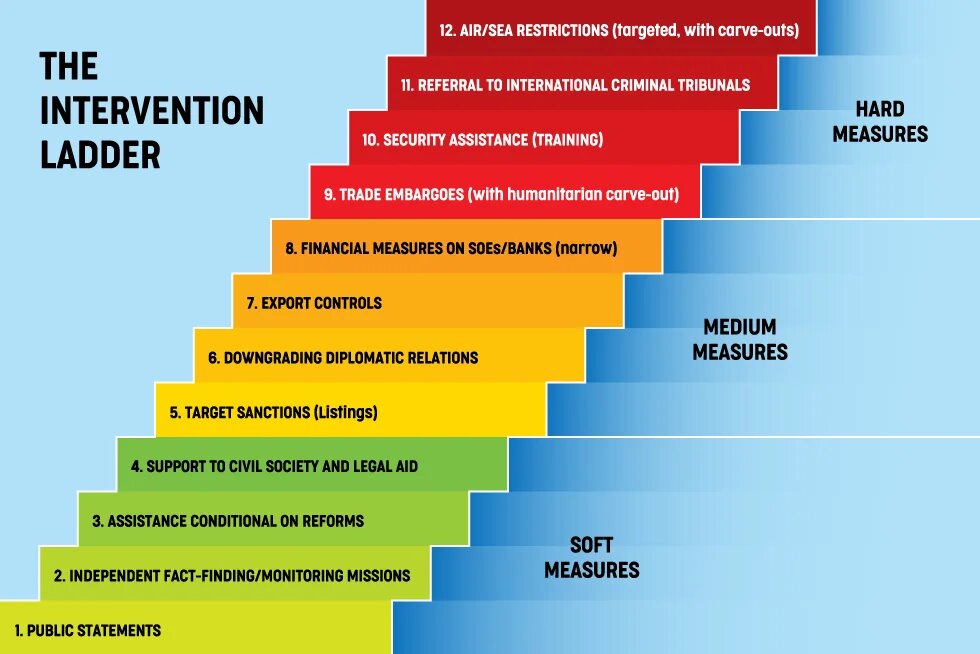
The research I conduct during this fellowship seeks to address this gap, with a clear question: Under which conditions do Greens and progressives move to or refrain from soft, medium or hard intervention measures as described in the Green Foreign Security Policy narrative? The toolkit, that will be created, aspires to map the available policy responses, pertinent to Green foreign policy principles and values. The policy responses will be depicted on a ladder with 12 ascending rungs and categorised in 3 respective intensity measures (soft, medium and hard). In this process, decision criteria and conditions for moving from one intervention level to the next will be set out, including with legal, ethical, and political thresholds rooted in the GFSP narrative.
For these reasons, the contribution presented will be both of analytic and practical nature. On the one hand, it will define a common vocabulary for the intervention spectrum, illustrating clear thresholds. On the other hand, it will translate the logic of the GFSP narrative into a clear Intervention Ladder which will be available for anyone to consult, along with the rest of the Toolkit and especially when time is pressing.
The plan of action
The research I am conducting during this fellowship follows a mixed-methods approach that combines theoretical research, expert interviews, experimental survey data, and case studies to develop the Toolkit. The work begins with a comprehensive literature and policy review, covering academic papers on interventionism and non-military foreign policy strategies, as well as official documents from Green party platforms. In addition to that, I am aspiring to run semi-structured interviews with Green Members of the European Parliament. These interviews will explore how Green actors perceive intervention, what criteria they use to make decisions, and how their past experiences have shaped current thinking.
Moreover, I also plan to distribute an experimental questionnaire to members of designated Green parties. Each respondent will be presented with four fictional crisis vignettes (describing scenarios involving soft, medium, hard, or no intervention) and will be asked to rate their support for various actions and assess their legitimacy. Lastly, a real-world case study, where Green parties were involved in foreign policy decisions will also be part of the analysis, offering practical insight into how the toolkit might function in real-life political contexts. The final result will be a practical guide in the form of a toolkit with an outline of principles for the Intervention Ladder, indices and guidelines based on well-known sources.
What exactly is the Intervention Ladder?
The Intervention Ladder is a structured spectrum setting out three levels of measures: soft, medium and hard. In the GFSP narrative, moving from one level of intervention to the next means meeting four criteria: legality, legitimacy, necessity & proportionality, effectiveness & feasibility of action. These conditions are manifested expressions of the narrative’s elements and they spring, for example, from the normative approach to foreign policy with the respect of international rules, the universality of human rights and the responsibility to protect, the principle of good faith and multilateralism, feminist foreign policy as well as many others. In practice, the more the measures move towards the hard end of interventionism, the more demanding conditions appear for their deployment. For this system to be consistent, two rules apply throughout.
On the one hand, sequencing. Skipping levels and ascending rungs without any well-grounded justification would constitute an exit from the GFSP narrative. This rule also works the other way round as an impediment to stagnation, since the justification and review of such measures is a continuous process. Indeed, it is crucial to step down when conditions improve or when harm outweighs the benefits of a measure applied. In a sense, sequencing is not only a technical requirement but also a parameter of a substantial nature, since its aim is to protect rather than impose.
On the other hand, clarity and specificity. Each measure should be bound to a clear state behaviour request and to measurable indicators for progress or setbacks. In that way, the Ladder provides transparency for all parties involved, including the electorate in democratic systems. It is also another layer of safeguard as far as arbitrary action or misuse of the Ladder is concerned. Nevertheless, along with typical instruments and goals, risk remains an aspect for each of the three rungs presented in the following diagram.
Soft measures focus on prevention and early response. Their purpose is to build leverage while keeping communication channels open and avoiding escalation. In practice, this includes public statements to signal expectations and set benchmarks, independent fact-finding and monitoring missions to verify information on the ground, assistance conditional on concrete reforms to support positive change through incentives, and direct support to civil society and legal aid to protect NGOs, journalists, and fundamental rights. These measures may also involve technical, legal, and humanitarian assistance, inclusive dialogue, transparency, and targeted cooperation on environmental, economic, or social issues. The overarching goal of soft measures is de-escalation, fact-finding, norm-setting, and harm prevention, without the use of coercion.
However, just like with every set of measures or procedures, there is always the aspect of risk. The benefit of incrementality in structures such as this is that risks tend to be more calculated and predictable. In detail, delay, tokenism, and the possibility that counterparts will instrumentalize engagement to buy time are some of the main risks in soft measures’ application. In order to counter that, decision makers should design soft measures with clearly defined milestones and consequences in case of non-compliance.
Medium measures increase pressure by introducing political and economic costs for non-compliance, while still keeping options and diplomatic channels open. They are typically used when soft measures have not led to sufficient change, or when the severity of the situation clearly justifies a stronger response. In all cases, progression to medium measures should remain proportional, transparent, and grounded in clear criteria. In practice, this rung includes targeted sanctions (listings) on individuals and entities responsible, downgrading diplomatic relations (for example, recalling ambassadors or limiting high-level contacts), export controls on high-risk goods and technology that could enable abuses, and narrow financial measures on specific state-owned enterprises or banks that materially support repressive practices. When these tools are well-targeted, conditional, and closely monitored, they significantly raise the stakes of non-compliance without fully closing the door on dialogue, cooperation, or future de-escalation.
Moreover, these measures of increased intensity come with increased risks. One of the main collateral risks is the potential impact of erroneous targeting which may mean consequences for vulnerable groups and sometimes even confusion about relief conditions. Although targeted in medium measures, trade restrictions for example may affect the local population as a whole and that is why clear criteria and humanitarian exemptions are essential when it comes to the planning and application of those measures. In balance, one of the most important risk-mitigating factors is the continuous review of applied measures, which help minimize collateral damage and ensure compliance with the GFSP narrative framework.
Hard measures form the third rung of the Ladder and are reserved for the most serious situations, as a last resort, when softer and medium measures have clearly failed or when the scale and gravity of violations demand a very strong response. In the GFSP narrative, their exceptional nature means more and stricter pre-conditions must be met the closer a measure moves towards open coercion: strong evidence, clear thresholds, and robust humanitarian safeguards. In practice, this rung includes trade embargoes with humanitarian carve-outs that restrict key economic flows while protecting access to food, medicine and aid; air and sea restrictions (targeted, with carve-outs) that limit overflight, landing or port access for implicated operators; referrals and support to international criminal tribunals to pursue individual accountability for serious crimes; and, in very specific and narrowly defined cases, security assistance and training designed to protect civilians under strict human-rights and oversight conditions.
These tools are the most politically costly options and should only be applied when they are clearly justified, proportionate, time-bound, and accompanied by humanitarian protections and defined pathways for de-escalation if behaviour changes. Hard measures entail substantial risks, such as unintended harm to civilians, escalation and retaliation, strengthening of authoritarian narratives, legal and legitimacy challenges, internal political costs, and the loss of strategic leverage if they are applied prematurely or without clear safeguards and exit paths.
GFSP decision criteria
Rooted in the GFSP narrative, the philosophy of the toolkit is built around three core pillars: human rights, international humanitarian law, and environmental stewardship and caution. Values are binding only if they can be operationalized and that is why this tool is not only relevant, but also necessary. A practical toolkit can provide both transparency and clarity of options for decisions to be made. The question is how do these pillars translate into foreign & security policy practice?
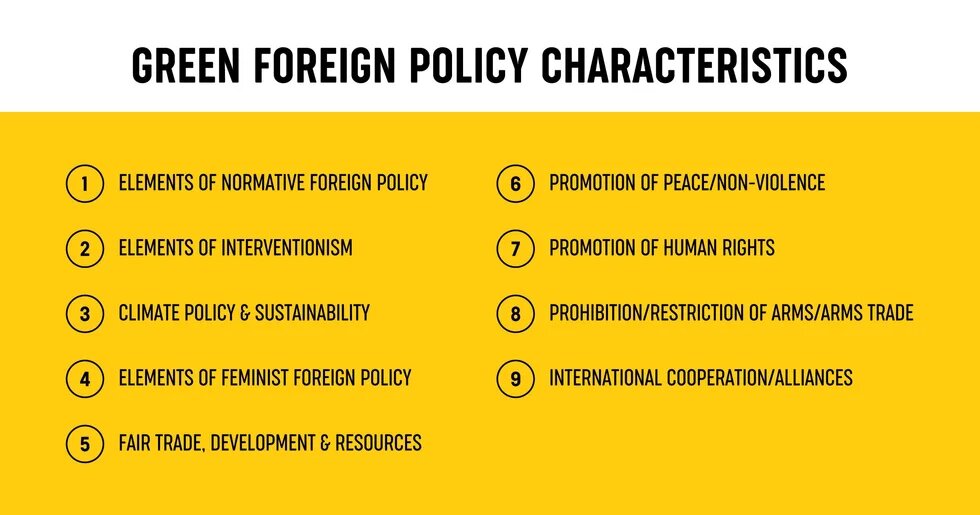
Starting from human rights as the first pillar, this work stresses the need for the minimum common denominator. It refers to a basic level of protections that prevent for example torture, disappearances, or discrimination, while safeguarding freedoms related to life, integrity, and association. In essence, this pillar mirrors the normative approach to foreign & security policy,[1] the elements of feminist foreign policy,[2] and the universality in the promotion of human rights[3] that form part of the GFSP narrative. At the same time, it acts as part of the foundational thinking for three of the four criteria, namely necessity & proportionality, legality and legitimacy.
The second pillar is international humanitarian law. As this pillar concerns the question of intervention, it is closely intertwined with the responsibility to protect and the legitimacy that comes with it. These rules of warfare govern acceptable behaviour during conflict, focusing on the duty to protect civilians or the principles of distinction and proportionality, setting limitations on how warfare can be conducted. In other words, the pillar works both as justification for an intervention and as a framework on how to conduct it. Here too, the normative approach to foreign & security policy[4] with the reference to rules is apparent, along with the promotion of peace and non-violence[5] which are part of the GFSP narrative.
Environmental stewardship and caution is the third pillar. It is about anticipation and prevention of environmental damage that comes with conflict, especially when that damage is used as a tactic or when it aggravates human suffering. It has many aspects that go beyond the obvious and it concerns long-term impact on the ground. Indeed, it is about the liveability of the affected areas after the war[6] preserving the natural resources present[7] and above all the sustainability of any peace arrangement after the end of conflict.[8] It is perhaps the most relevant when it comes to checking the effectiveness and feasibility of an intervention measure, an essential aspect of the GFSP narrative.
Although these pillars provide the reasoning upon which the Intervention Ladder stands, they are not practical when it comes to deciding on specific action. This role belongs to the four checks which are required when deciding whether to move up or down the Intervention Ladder, narrowing down the available options and screening out steps that are ill-fitting. Importantly, within this system, escalation is an option only when all four checks below are met.
Legality asks whether the action is allowed by law and supported by a trusted body, such as a court, an official investigation, or a UN or regional mandate. Legitimacy explores if there is a broad backing from other states or institutions, avoiding any arbitrary actions. Necessity along with proportionality questions whether the action is truly needed, if its benefits outweigh the potential harms and whether less intrusive options have already been tested / tried. Finally, effectiveness and feasibility explore whether there is a credible path from action to the expected change in behaviour. Undeniably, these checks should be supported by facts and credibility. In essence, these checks structure communication, build the narrative and provide transparent thresholds for moving up or down the Ladder, conveying clear messages about the intentions and end goals.
In conclusion
The Intervention Ladder illustrates a path for Greens and Progressives to turn principles into practice. By considering the four checks of legality, legitimacy, necessity & proportionality, effectiveness & feasibility, it becomes possible to justify escalation or restraint in a transparent manner. These conditions could improve speed, coherence, and public trust as choices are documented, conditions for change are explicit, and off-ramps are included. The Green Intervention Toolkit puts this idea into action. It provides decision-makers with a common language and a decision tree for checking evidence, assessing harm, and communicating with the electorate in a transparent and effective manner.
[1] Heinrich Böll Foundation Thessaloniki (2023), Green Foreign Policy Snapshots, Preliminary findings report, Characteristic 1
[2] Heinrich Böll Foundation Thessaloniki (2023), Green Foreign Policy Snapshots, Preliminary findings report, Characteristic 4
[3] Heinrich Böll Foundation Thessaloniki (2023), Green Foreign Policy Snapshots, Preliminary findings report, Characteristic 7
[4] Heinrich Böll Foundation Thessaloniki (2023), Green Foreign Policy Snapshots, Preliminary findings report, Characteristic 1
[5] Heinrich Böll Foundation Thessaloniki (2023), Green Foreign Policy Snapshots, Preliminary findings report, Characteristic 6
[6] Heinrich Böll Foundation Thessaloniki (2023), Green Foreign Policy Snapshots, Preliminary findings report, Characteristics 3 & 7
[7] Heinrich Böll Foundation Thessaloniki (2023), Green Foreign Policy Snapshots, Preliminary findings report, Characteristic 5
[8] Heinrich Böll Foundation Thessaloniki (2023), Green Foreign Policy Snapshots, Preliminary findings report, Characteristic 6