

ARTICLE
As a Green Foreign Policy Fellow of the Heinrich Böll Foundation Thessaloniki in 2025–2026, Stacy Achieng Ogembo aims to examine how East African Green Parties localize and reinterpret normative foreign policy as an element of the green foreign & security policy narrative. She traces how global green values intersect with regional histories, institutions, and political realities as an antidote to any colonialist tendencies often found in norms and ideas emanating from other regions of the world.

Introduction
Over the past decades, the “greening” of foreign policy has emerged as a question for international relations. Several political actors including green and progressive political parties have begun giving this aspect more thought when making policy. Green Foreign Policy (GFP), still lacks a commonly agreed definition but it seems to be rooted in values such as the universality of human rights, environmental justice as opposed to extractivism and colonialism, non-violence, peace, feminist foreign policy, multilateralism and good faith in international relations, as well as the centrality of international bodies and rules for the international system. At least that is what the findings of Green Foreign Policy Snapshots: Preliminary Findings Report (GFPS) suggest, a report published by the Heinrich Böll Foundation in 2023. Although the report is based on findings from across the globe, the wider green agenda has largely been described in the Global North and has spread worldwide through a variety of institutions and political thought processes.
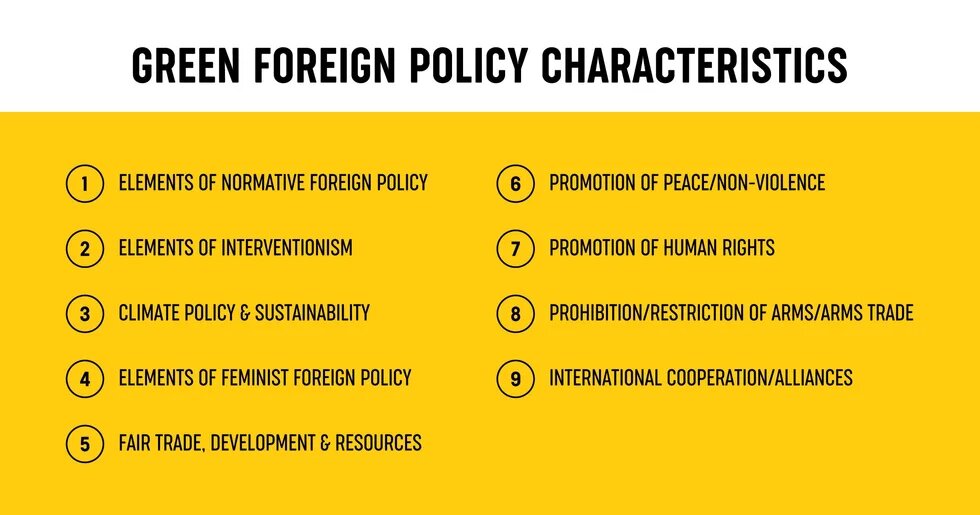
Indeed, western international non governmental institutions have carried environmentalism as a norm with them, enabling it to also diffuse in the Global South. In addition to that, many Green political parties in the Global South are still in the process of tracing their steps when it comes to bridging local reality and the ecological wisdom of indigenous communities with the green political thought as it was developed in the Global North. As a Green Foreign Policy Fellow and a PhD Candidate at the Technical University of Darmstadt working on the Standards of Governance, I see here a gap requiring further study when it comes to the green foreign & security policy narrative in the Global South. Picking up the baton from the GFPS report, which identifies nine distinct elements for the green foreign & security policy narrative and explores interconnections between them, my intent is to focus on East Africa as a region and look deeper into the official documents of Green parties, identifying disparities and valuable insights for foreign & security policy stances.
Specifically, I am interested in examining how Green parties in the East Africa region engage with “Elements of Normative Foreign Policy” found as part of the green foreign & security policy narrative in GFSP (characteristic 1), not only as “agents of change” but also as smaller political actors. Green political parties in Africa have attracted less academic/empirical attention compared to their counterparts in the Global North. Working on this topic would also build on green politics research by offering a perspective that is relevant to the contexts of Green parties in the Global South. Moreover, the research could potentially build on the wider spectrum of the green foreign policy narrative with a decolonial perspective. But how exactly does this work feed into the open discussion on the green foreign & security policy narrative?
While green politics have become an increasingly influential force in western Europe, firmly embedded within the spectrum of left-wing politics, in Africa it remains more emergent and fragmented, with green parties still struggling to gain comparable political visibility and institutional strength. The African Greens Federation members, according to their website, counts 22 member parties, yet only seven maintain active official websites, and just two parties—represented by Didace Pembe Bokiaga in the Democratic Republic of the Congo and Ndimadjingar Assane Maurice in Chad—currently hold seats in national parliaments. Of the seven African Green parties that maintain active official websites, three are based in East Africa, offering a particularly fertile research ground for comparatively examining how normative foreign policy (NFP), as a characteristic of GFP, is articulated within the East African Community (EAC) bloc. These three parties, the Democratic Green Party of Rwanda (DGPR), the Ecological Party of Uganda (EPU) and the Green Congress of Kenya (GCK), share transboundary challenges such as climate change, migration, security threats, and resource governance, they operate under different political systems and are members of the Eastern Africa Greens Federation (EAGF).
My work will focus on the “Elements of Normative Foreign Policy” (characteristic 1), which is foreign policy anchored on international rules and institutions, reducing uncertainty in the international system. In the same vein, the work of Nathalie Tocci (2008) has extensively analysed this, describing normative foreign policy to be foreign policy grounded in milieu goals. In other words, policy with an aspiration to shape the global environment based on universal principles rather than the pursuit of narrow national interests. This commitment is clearly reflected in the Global Greens Charter, which outlines the green movement’s core values such as “ecological wisdom, social justice, equality, freedom, participatory democracy, non-violence, sustainability, and respect for diversity.”
Nevertheless, existing research on Green parties, both in Europe and globally, has paid limited attention to the dimension of the green foreign & security policy narrative. As highlighted in the GFPS (2023), scholarship in this area remains sparse. In particular, there is little to no systematic analysis of how Green parties in the Global South, and East Africa in particular, articulate their foreign policy positions. Crucially, no study has yet examined normative foreign policy as a defining characteristic of Green Foreign Policy. My work during this fellowship will seek to address this gap through qualitative content analysis, supplemented by interviews to answer following research questions. To what extent is Green Foreign Policy-indicative language present in the manifestos/principles/constitution and vision of East African Green parties? How do the DGPR, GCK and EPU articulate normative foreign policy elements? To what extent do the policy positions of the DGPR, GCK and EPU reflect, expand, or challenge existing International Relations (IR) theories?
Deep dive: bridging theory with practice
Guided by the hypothesis that Green Parties in East Africa articulate foreign policy in ways that are shaped by the historical, geographical and local context they operate in, the research I will conduct will draw on norm localization theories in International Relations. These theories emphasize that local actors reconstruct norms to fit their individual contexts (Acharya, 2004). Moreover, establishing a link between Green Foreign Policy (GFP) and IR theory is critical for situating these parties within broader theoretical frameworks. In this direction, three IR theories will be included in the process: liberal institutionalism, green theory, and postcolonial theory.
But why these IR theories? On the one hand, liberal institutionalism highlights cooperation among states and the role of institutions in achieving collective goals, making it relevant to the Greens’ emphasis on international law, regional and international organizations (UN, AU, EU, EAC) and multilateralism. Green theory, on the other hand, articulates concerns of many voices traditionally at the margins of international relations such as green political parties. In addition to that, postcolonial theory is also included because it addresses the voices and concerns of the Global South actors, providing a framework for understanding how East African Green Parties adapt and reinterpret global norms within their own contexts.
From a policy standpoint, the study will shed light on how East African Green Parties position themselves within the wider political and international landscape. By identifying the presence of GFP language and the parties’ engagement with international norms, the research will provide insight into how smaller political actors in the Global South articulate global governance issues. Climate action, the universality of human rights, peace, international cooperation, institutions, and sovereignty are only some examples. This knowledge can inform networks such as the Global Greens in engaging with East African Green Parties, and support strategies for strengthening party visibility and policy influence.
The proposed research will adopt a two-stage analytical approach. The first stage is crucial for identifying the presence (or absence) of GFP tenets within the ideological and policy frameworks of East African Green parties. It will aim to determine whether, and to what extent, the language found in the selected parties’ manifestos, constitutions, principles, and vision statements aligns with any of the GFP elements identified in the GFPS report. The second stage of the research will increase the focus by looking closer into the Elements of Normative Foreign Policy.
Where to?
The findings may reveal a fragmented or limited expression of the green foreign & security policy narrative, given that the concept is still in its early stages of development. This fragmentation could portray a selective prioritization of the narrative and not necessarily by contextual default or lack of sufficient expression. Instead, it may demonstrate a reflexive pattern anchored in the vision and mission of green political parties in East Africa. At the same time, the analysis has the potential to highlight how the narrative can be localized in the Global South, thereby contributing to the broader debate.
The endeavor aims to diversify the intellectual foundation of Green Foreign Policy beyond Eurocentric lenses. It will offer a more focused framework to better understand how East African Green Parties position themselves within global foreign policy debates. It will also attempt to ground the debate on International Relations theory, looking into whether liberal institutionalism, green theory, or postcolonial theory, provides the most convincing explanation of these parties’ approaches to normative foreign policy. East African Green Parties, though still nascent and institutionally limited, represent important carriers of normative foreign policy that link local struggles with the green foreign & security policy narrative. Although such a journey has challenges ahead, all we need is a good compass and the will to shed light into how normative commitments are interpreted within different political, economic and historical settings, thereby developing the Green foreign & security policy narrative at the same time.