

ARTICLE
As a Green Foreign Policy Fellow of the Heinrich Böll Foundation Thessaloniki in 2025–2026, Falguni Lalwani examines whose voices shape green foreign and security policy and how intersectionality can shift from symbolic reference to structural practice. Her work aims to outline the analytical pillars and tools designed to embed feminist, decolonial, and redistributive principles into policy.

Cynthia Enloe’s enduring provocation — “Where are the women?” (1989, p. 133) — remains as urgent as ever. However, amid accelerating climate crises, geopolitical fragmentation, and widening inequalities, this question needs sharpening: “Which women?” “How about other vulnerable groups?” “Whose voices?” “Whose future?” These questions are not just symbolic; they shape who gains access to resources, whose priorities drive climate finance, and whose vulnerabilities remain invisible. As a Green Foreign Policy Fellow of the Heinrich Böll Foundation, a researcher from the Global South, and an International Political Economy graduate from the London School of Economics, my positionality anchors this work. It shapes my focus on whose voices travel into policy frameworks, whose are excluded, and how intersectional justice can be meaningfully embedded. I see this as a critical juncture for intersectionality, climate diplomacy, and consolidating progressive foreign policy narratives more broadly. The urgency is both temporal and substantive.
Governments and multilateral institutions are already designing and funding large-scale energy transitions, adaptation strategies, and climate finance pathways. Still, current flows remain far below what is needed. Global climate finance reached USD 1.46 trillion in 2022. Still, a further fivefold increase is required to get the USD 7.4 trillion annually through 2030 under the 1.5 °C scenario (Naran et al, 2024). These decisions are not just technical but political, determining whose priorities shape financing frameworks and whose vulnerabilities remain invisible. Without explicit intersectional criteria, procedural safeguards, and accountability frameworks, “green transitions” risk replicating extractive hierarchies, privileging certain economies, voices, and knowledge systems while marginalizing those most affected by climate vulnerability. In this context, the preparedness of Greens and other progressive political parties is paramount.
Responding to this urgency, during this fellowship, I aim to narrow the gap between declaratory aspirations, policy, and practice regarding intersectionality in foreign policy, with a toolkit specifically designed for that purpose. By analyzing Green party platforms and related policy frameworks in Germany, Canada, and India, my work will operationalize intersectionality within foreign policy design, shifting feminist foreign policy (FFP) from symbolic recognition to structural transformation. To achieve this, the toolkit will include a set of actionable tools and criteria to translate feminist, decolonial, and redistributive principles into practical pathways for implementation. But this challenging task will only be one piece of a larger puzzle, consolidating a progressive foreign & security policy narrative.
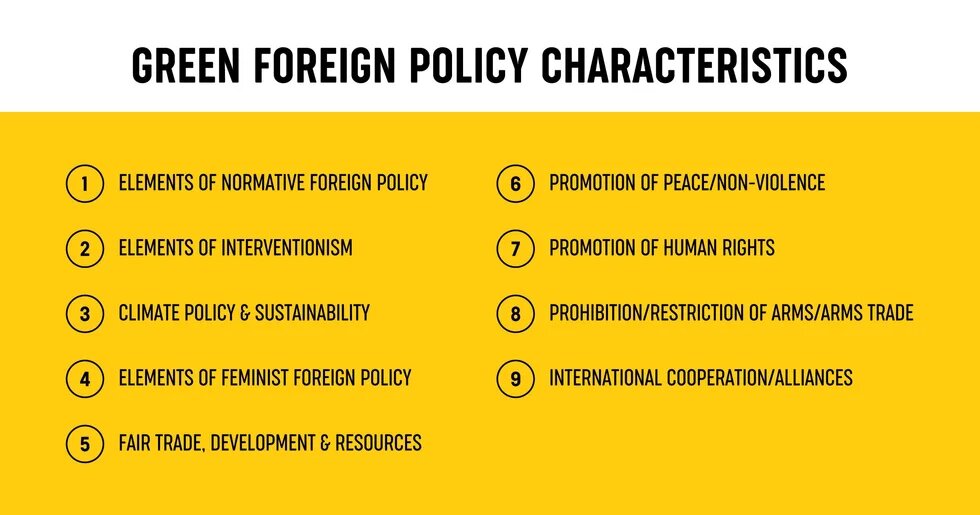
Across the world, Green and progressive actors have led on climate and foreign-policy agendas, with many governments adopting Feminist Foreign Policy (FFP) — including Canada, France, Spain, Mexico, Chile, Germany, Luxembourg, Colombia, the Netherlands, Mongolia, Slovenia, and Liberia — though some have since shifted course, as Sweden scaled back FFP in 2022 (Thomson & Wehner, 2025). In 2023, the Heinrich Böll Foundation published Green Foreign Policy Snapshots (GFPS), which revealed that references to “women and girls,” LGBTQI+ inclusion, and human rights are highly prevalent across Green party platforms globally. This project builds directly on GFPS, focusing particularly on four of its nine elements: feminist foreign policy (Characteristic 4), “Fair Trade, Development & Resources” (Characteristic 5), “Climate Policy & Sustainability” (Characteristic 3), and “Promotion of Human Rights” (Characteristic 7). These provide the broader framework within which the toolkit translates feminist, decolonial, and redistributive principles into actionable strategies.
Feminist foreign policy remains an evolving concept, and further analysis is required to understand how these aspirations are translated into policy. With COP30 approaching and demands for people-led climate solutions rising, decisions taken now will shape distributional outcomes for decades. The need for transformative frameworks has never been greater. It is time for Green and progressive political parties to move beyond rhetoric and embed intersectional, feminist, and redistributive values at the heart of their foreign policy agendas. But what exactly will the Intersectionality Foreign Policy Toolkit analyse, and what tools will it include?
Four thematic pillars
The analysis for the toolkit will be grouped around four thematic pillars: Positionality and Voice, Climate Justice and Redistribution, Humane Security, and Decolonial Practice. These pillars directly respond to gaps identified in Green Party platforms and policy frameworks, offering a structured way to assess how deeply intersectional and feminist commitments are embedded. They form the analytical framework for comparative discourse analysis and the toolkit design, enabling Green and progressive parties to assess, reform, and formalize intersectional commitments within their foreign policy agendas. The aim is to bridge theory and practice, moving from normative aspirations to practical pathways, with instruments designed to embed intersectional justice within the foreign policy design of Green and progressive parties.
- Pillar A: Positionality and Voice
Whose voices are centred and whose are excluded? This pillar will address intersecting identities, including caste, class, indigeneity, race, and migration status. Indicators assess whether diverse knowledge systems and lived experiences are meaningfully integrated, moving beyond generic references to “women and girls.”
- Pillar B: Climate Justice & Redistribution
This pillar explores how gender justice is framed in relation to redistribution in foreign policy discourse. It will examine whether official climate and development policy documents link gender to structural inequalities such as global resource flows or economic justice, or whether gender is framed in depoliticised, symbolic terms. This helps assess how far feminist foreign policy moves beyond inclusion toward material redistribution.
- Pillar C: Humane Security
Realist theories and security frameworks privilege militarisation and territorial dominance, often overlooking how climate risks, migration crises, and gender-based violence shape security. This pillar will investigate security through the lens of human security, focusing on care, ecological well-being, and autonomy. It will analyse the extent to which Green Party platforms adopt holistic approaches to security and to what extent.
- Pillar D: Decolonial Practice
Climate justice demands dismantling colonial legacies embedded in trade, development, and diplomacy, which aligns with the “Fair trade, Development & Resources” element in GFPS and the green foreign & security policy narrative. This pillar examines whether policies centre Global South leadership, Indigenous sovereignties, and alternative epistemologies, embedding reparative justice into foreign policy frameworks.
Methodology and tools
The research will begin with a comparative discourse analysis of Green Party platforms, policy documents, ministerial speeches, and climate diplomacy statements in Germany, Canada, and India. Guided by the four thematic pillars, the analysis will investigate how policy language frames or omits intersectionality, redistribution, human security, and decoloniality. By examining variation across contexts, the goal is to identify gaps and highlight pathways where Green and progressive parties can embed intersectional feminist values more systematically.
Building on these insights, the Toolkit translates feminist and decolonial principles into four concrete, user-friendly tools designed to help parties move from normative aspirations to actionable policy pathways:
- Tool A: Language Audit Template
A set of reflective questions to evaluate whether policy language is inclusive or tokenistic, and whether it reinforces or resists depoliticising narratives. This tool encourages parties to interrogate their framing choices more critically.
- Tool B: Positionality Mapping Guide
A visual and analytical tool to help policy actors assess which identities, knowledge, and communities are centred, marginalised, or excluded. It focuses on intersections like caste, class, migration, and race, ensuring that commitments to inclusion move beyond symbolic references.
- Tool C: Policy Assessment Matrix
A practical self-assessment tool designed for Green and progressive parties to evaluate their foreign policy platformsagainst the four thematic pillars — Positionality & Voice, Climate Justice & Redistribution, Humane Security, and Decolonial Practice. Using guiding questions and indicators, the matrix helps parties map their policy commitments on security, trade, and environmental justice, identify gaps, and strengthen alignment with intersectional feminist and redistributive values.
- Tool D: Self-Assessment Checklist
An action-oriented checklist designed for quick evaluation of whether party platforms meet intersectional feminist goals. It includes suggested clauses, reflective questions, and accountability prompts, helping parties embed measurable indicators into their foreign policy design.
By linking discourse to material practices — including climate finance, trade regimes, and equitable development pathways — the Toolkit equips Green and progressive parties to move from symbolic recognition to institutionalized change. It bridges feminist, decolonial principles and concrete implementation strategies, ensuring that commitments translate into policy transformation.
Deep dive: symbolic feminism vs. structural justice
Feminist Foreign Policy has gained momentum across progressive political movements, promising to reshape global diplomacy around equality, care, and solidarity. The GFPS report shows that Green Party platforms frequently reference “women and girls,” LGBTQI+ rights, and human rights. This suggests an emerging normative foundation in the Green foreign & security policy narrative. However, it also notes that FFP remains underdeveloped and calls for a deeper analysis of how these commitments are embedded within policy frameworks.
During this fellowship, I will build on that observation by asking a critical question: Do these frequent references signal structural integration or remain largely aspirational? This distinction reflects Nancy Fraser’s (1997) tension between recognition and redistribution. While symbolic gestures, representation, visibility, and rights language are necessary starting points, they are insufficient if they fail to address more profound questions of power, access, and justice. Without interrogating whose voices are centred in foreign policy, who controls resources, and whose knowledge systems are recognised, feminist foreign policy risks reproducing existing hierarchies under a “green” label.
The GFPS identifies feminist foreign policy (characteristic 4) as a highly prevalent element of the green foreign & security policy narrative, indicating strong normative aspirations. However, it leaves open critical questions that this project investigates through a comparative analysis in Germany, Canada, and India:
- Do policy frameworks engage with caste and class-based exclusions in climate vulnerability?
- Do feminist assistance strategies integrate Indigenous sovereignty and migration-based inequities?
- Have existing FFP guidelines also addressed race and migration?
Similarly, the “Fair trade, Development & Resources” element (characteristic 5) in GFPS — linking feminist commitments to fair trade, resource governance, and development raises critical questions. While Green platforms reference decolonial values and sustainable resource management, I will examine whether these commitments are consistently connected to redistributive climate finance, equity claims from the Global South, and just trade regimes. Without such integration, “green transitions” risk replicating extractive logics under sustainable branding.
By positioning intersectionality not as token inclusion but as a systemic critique of power, I will reframe FFP as a redistributive project during this fellowship. Drawing on Naila Kabeer’s (2015) critique of inclusionary frameworks that mask structural inequalities, it develops tools for accountable policymaking that connect policy language to measurable outcomes, enabling Green parties to confront power asymmetries within global governance.
Why Green parties, why these cases?
Green parties occupy a distinctive place in global climate and foreign-policy debates. Anchored in the Global Greens Charter (2023)—which commits them to ecological wisdom, social justice, sustainability, human rights, and more—they often cast themselves as moral leaders on ecological wisdom, social justice, and respect for diversity. Yet organizational capacity, political influence, and policy priorities vary widely across contexts, making Green Parties a revealing site to study where feminist and intersectional principles are translated into foreign policy and where they remain aspirational.
My work focuses on Germany, Canada, and India because they represent three analytically contrasting entry points into these debates. Germany provides a case where formal Feminist Foreign Policy guidelines were adopted in 2023, positioning gender equality as a central pillar in diplomacy, development, and climate policy. This provides an opportunity to explore how normative commitments are institutionalised in practice. Conversely, Canada has one of the earliest and most widely recognised feminist policy frameworks: the Feminist International Assistance Policy (FIAP), introduced in 2017. Its prominence in global development discourse makes it a valuable case to study how feminist priorities are articulated within aid, trade, and climate diplomacy. In contrast, India provides a different perspective from the Global South. As a climate-vulnerable country balancing development and sustainability goals, India illustrates how intersectionality might be framed or contested in contexts where Green parties have less electoral significance and socio-economic pressures shape climate and foreign policy debates.
By comparing these three contexts, this work will investigate how feminist foreign policy aspirations are expressed across diverse political and regional settings. Rather than assuming what is present or missing, the analysis examines how deeply feminist, intersectional, and decolonial principles are operationalised within Green Party platforms and related policy frameworks. The project generates globally relevant insights through these contrasts while remaining grounded in each context’s political, historical, and socio-economic realities.
The urgency of transformation
As the world prepares for COP30[1] in Belém in November 2025, debates over climate reparations, trade justice, and North–South equity are gaining traction. According to civil society groups like ESCR-Net, there is a growing demand that the COP30 Centre “justice and reparations for communities historically harmed by colonialism, environmental racism, and dispossession.” However, within these negotiations, gender justice remains marginalized—often invoked symbolically rather than embedded within institutional rules and decision-making structures. Evidence from WEDO shows that women remain underrepresented in national delegations and decision-making roles across UNFCCC processes, highlighting the need for stronger integration of gender-responsive approaches.
Green parties are well-positioned to shape this transformation. Across regions, they have built identities around ecological justice, sustainability, and human rights. The GFPS report shows that many Green platforms strongly endorse gender equality (Characteristic 4), fair trade, and resource justice (Characteristic 5). However, as a preliminary mapping exercise, the report underscores that these commitments often remain normative aspirations unless accompanied by mechanisms for policy integration, redistributive financing, and structural accountability.
My work as a Green Foreign Policy Fellow will address that implementation gap. The Intersectionality Foreign Policy Toolkit will operationalize intersectionality, providing both Green & progressive parties and policymakers with concrete procedures, indicators, and decision rules to translate feminist aspirations into actionable strategies. By embedding justice directly into foreign policy design, the project moves Green foreign policy from recognition to redistribution, enabling more equitable, accountable, and transformative governance at a pivotal moment in global climate politics and the green foreign & security policy narrative.
References:
Fraser, N. (1997) Justice Interruptus: Critical Reflections on the ’Post-socialist’ Condition. London: Routledge.
Kabeer, N. (2015) ‘Gender, poverty, and inequality: a brief history of feminist contributions in international development’, Gender & Development, 23(2), pp. 189–205. doi:10.1080/13552074.2015.1062300.
Enloe, C. (1989) Bananas, Beaches and Bases: Making Feminist Sense of International Politics. Berkeley: University of California Press.
Astyrakakis Aslanis, E. (2023) Green Foreign Policy Snapshots: Preliminary Findings Report. Heinrich-Böll-Stiftung Thessaloniki. Available at: https://gr.boell.org/en/2023/09/13/green-foreign-policy-snapshots
[1] The next COP, COP30 refers to the 30th Conference of the Parties under the UNFCCC, scheduled for 10–21 November 2025 in Belém, Brazil. A key focus is advancing the “Baku‑to‑Belém Roadmap,” which seeks to scale climate finance to USD 1.3 trillion annually by 2035, and prioritize implementation of loss & damage, adaptation, and equitable finance frameworks.