NEIGHBOURHOOD DISCUSSION
As a city that is being transformed almost by chance and primarily for the sake of profit, reproducing “hostile” urban forms for its residents, Thessaloniki was described, among other things, by those who took part in the neighbourhood discussion organised as part of the Social Atlas of Thessaloniki initiative entitled “From Ladadika to Vardaris: Neighbourhoods on the Move”. The event took place on 18 October 2025 with the support of the Heinrich Böll Foundation – Thessaloniki Office.
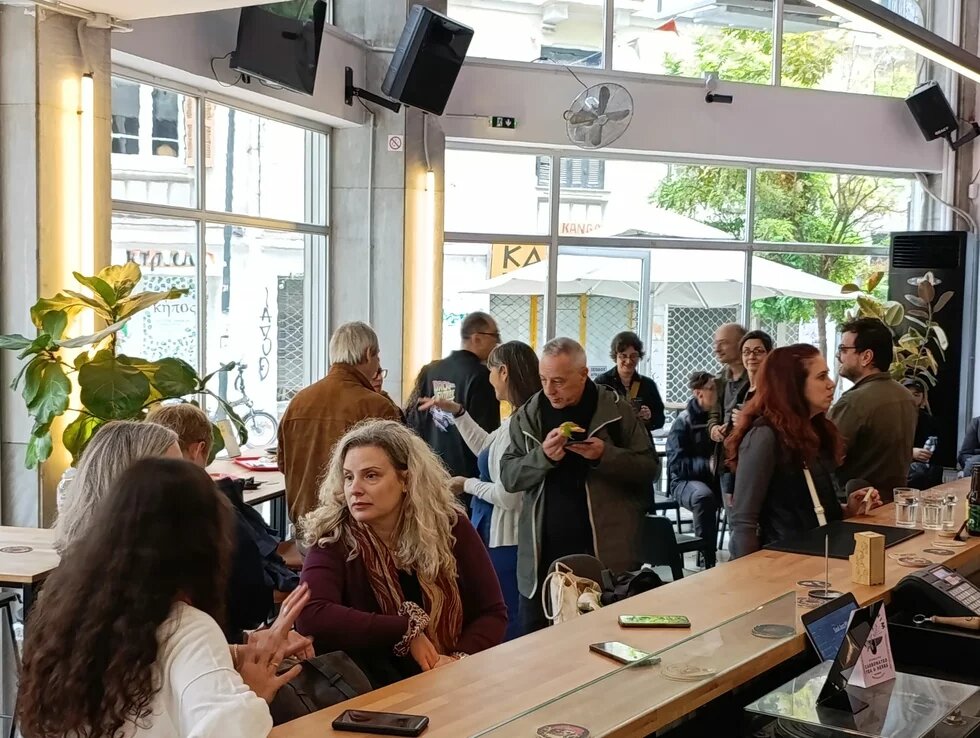
It was also portrayed as a city that seems to drive out, to intimidate, to threaten and ultimately to turn against its own residents, as emerged during the same discussion at Utopia bar in Mavili Square, where participants were invited to share thoughts, ideas and feelings about the contemporary urban transformations of Thessaloniki.

“We are under attack”
“It is a city that is changingand not only fails to include us, but actually attacks us,” a musician remarked, describing the displacement of artistic communities from the centre of Thessaloniki due to the dominance of short-term rentals.
“We used to hear music coming out of the buildings. Now all those musical communities have been displaced. There is a constant sense of threat. We are under attack and, in my view, questions of citizenship are at stake. When threat, need and deprivation converge, the time for action comes,” she added.
The lack of green space and the unaffordable cost of housing, as well as commercial premises, in the centre of Thessaloniki is forcing more and more residents to move.
“I live in the area of the Roman Agora and I feel a significant lack of green space. I am also increasingly concerned about finding housing. You simply can’t keep up financially with the rise in rents recorded in recent years. With the same amount of money I now pay for a small flat that accommodates just me and… my cat, a family in the past could have rented a larger home. Changes are taking place in Thessaloniki, but without us. We do not have the opportunity to participate in these changes. I feel that we have no say…,” said, among other things, a worker who lives in the city centre.
“We were forced to give up the commercial space we maintained in the centre because it became an Airbnb. We moved west, where it is cheaper, but I don’t know how much further west we will go in the future, or who will be able to endure it,” it was noted during the discussion.
“There are fear and insecurity among those who live in the centre about when the time for eviction will come. Businesses, groups and residential tenants are being displaced,” it was pointed out.
Without a plan
Participants in the discussion also highlighted the lack of planning and the urban transformations that stem from profit. “We live in an ugly city, in which there are certain pleasant voids. This city never had –and still does not have– any kind of plan. Everything happens somehow… by chance, but what is certain is that profit remains the primary guiding principle. Lately, we have also been witnessing a devaluation of archaeological sites and monuments that is beginning to take on epidemic proportions. No one is going to ask us about anything,” remarked one of the discussion participants.
“The major projects decided for Thessaloniki are not guided by any coherent plan. In some strange way, decisions are made and simply imposed on us. I come from a provincial town and initially moved to Thessaloniki to study. Many of us wanted to live in this city. At first, we were dozens. Today, only two of us remain from that ‘generation’. I think that says a great deal,” stressed another participant in the discussion.
“It makes me angry that I cannot move around in my neighbourhood”
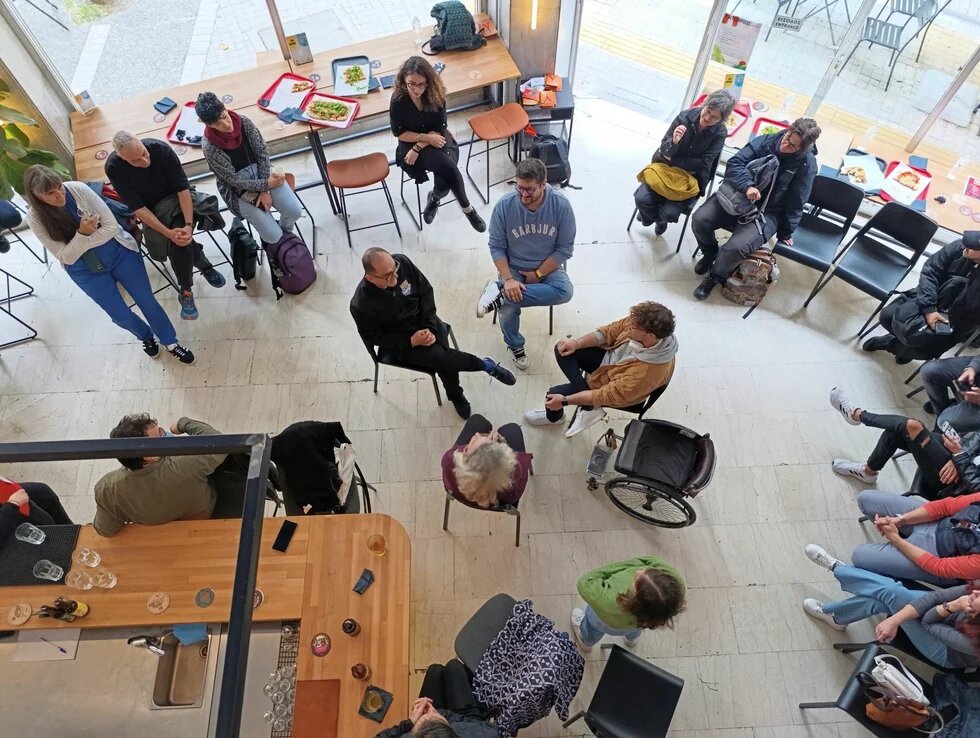
A young man who lives in the area between Vardaris and Ladadika and uses a wheelchair expressed his anger at the municipality’s indifference, as well as his disappointment at the lack of collective action that could help address the major obstacles he faces in his daily life.
“It makes me angry that I cannot move around easily in this neighbourhood. There are no ramps. I have contacted the Municipality of Thessaloniki, but I ’m met with indifference. I feel that I have to do something myself in order to respond to this situation. Unfortunately, we have to fight for what should be self-evident. I have already bought a jackhammer and, with a compressor, I will start breaking up the concrete to build ramps myself! There is nothing else I can do. I have tried to mobilise other disabled people I meet in the neighbourhood and have come to know, so that we can take collective action, but I encounter a mentality according to which ‘nothing can be done’. I feel alone… Either we go abroad or we stay inside our homes and become institutionalised,” he said, among other things, during the discussion.
Memories from the 1980s
A man who ran a clothing workshop in the area described, from his personal experience, the transformation of this neighbourhood. As he explained, until the early 1980s it had been a disreputable area, but it then began to change with the many small manufacturing workshops that sprang up. “It was a lively area because of the large number of people working in these workshops. You could get here by city bus, no matter which area you lived in. All the shops around here were full. It was a proper… festival. We had a good time. You don’t find that today,” he said. According to him, these bustling streets began to empty out in the late 1990s, as several workshops shut down, while others relocated. His own business moved to the area of Oreokastro. “They drove us out, just as is happening today to the shopkeepers and professionals who have remained in the area. It’s a shame. People don’t have work. We loved this neighbourhood. It was good back then too. We may not have had wide pavements, but we had life,” the man recounted.
“Alienation…”
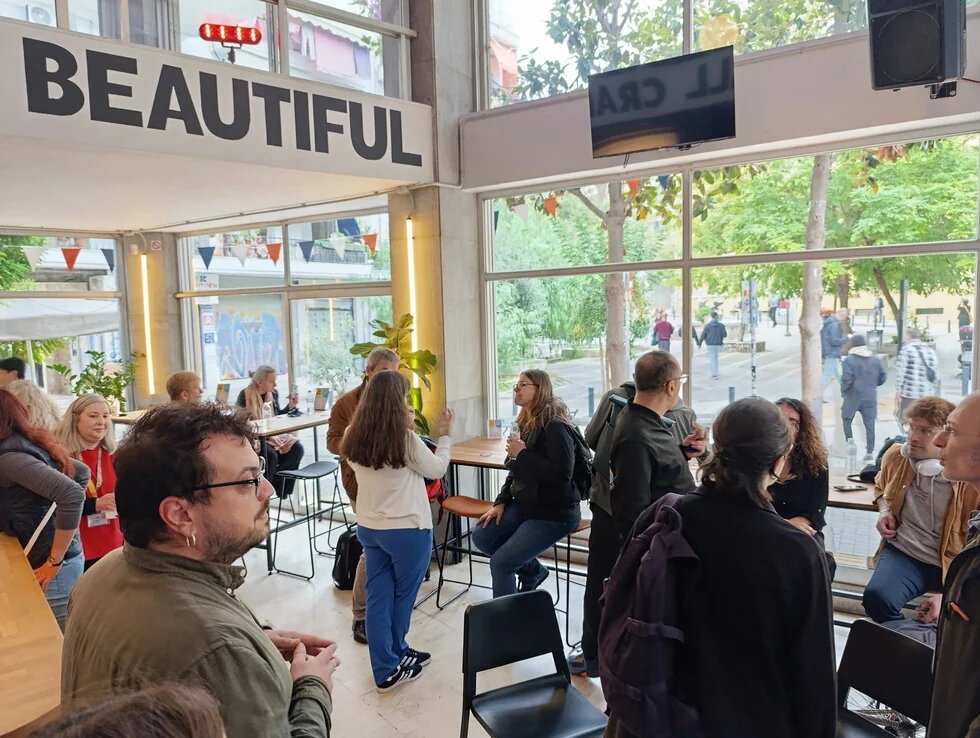
One of the participants described, in personal terms, his “journey” through the neighbourhoods of central Thessaloniki during the event. “From the Upper Town (Ano Polis), near the city walls, where life is more family-oriented and reminiscent of village life, I moved to the centre, where I experienced alienation. People there do not even say good morning. Now that I have moved to the area around Monastiriou Street, I will have to learn two or three languages to communicate with my neighbours. In what we consider the city centre here in Thessaloniki –that is, from Vardaris to Angelaki Street– short-term rentals have now become dominant,” he stressed, among other things.
“I really miss benches in this city. I feel there simply aren’t enough of them,” said a self-employed professional during the discussion, recounting his unsuccessful attempt to “adopt” two flower beds in the city centre. “We built a wooden structure, planted flowers and created a beautiful space. But neighbours and local residents had a different view and, in various ways, sabotaged the effort. In the end everything withered and was destroyed,” he noted, among other things.
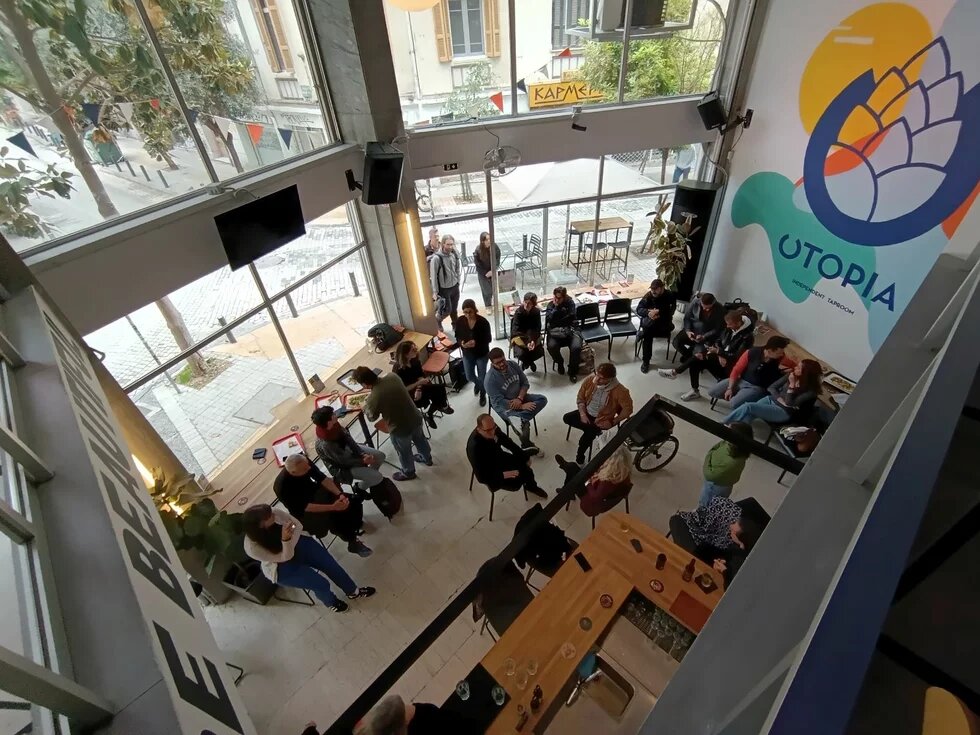
“A major desertion is coming to the centre of Thessaloniki”
The transformation of Thessaloniki’s centre into a destination for tourism and leisure was described by a resident who was born and raised in this part of the city.
“I am a child of the city centre, where truly everything used to happen. There was production, housing, entertainment. Everything coexisted. I used to walk around the streets on my own from the age of seven. Today, if you walk through the centre, you don’t see children around. Back then there were watchful human eyes looking out for children. That no longer exists today. Now you see shuttered storefronts, and shops that do not cater to residents of the centre. That diversity of the past has been lost. One of the issues I faced as a mother was that there are no playgrounds in the centre. The naturalness of the city has been lost. The centre has been abandoned. There is no care. What is needed is participation and self-organisation in order to make claims,” she noted, among other things.
She also predicted a “major desertion of the centre of Thessaloniki” in the coming years. “It seems that a model similar to the one adopted in Ladadika is being followed: shops and businesses everywhere, either for tourists or for leisure, without serving the residents of the area. On weekdays the centre is almost dead. Even neighbourhoods that had remained neighbourhoods are beginning to lose their character.”