

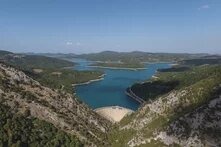
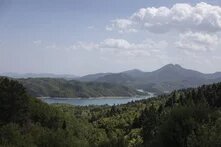
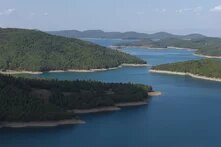
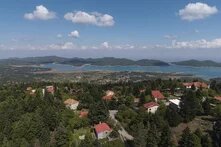
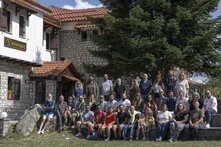
With the participation of around 40 people from Attica, Epirus, Thessaloniki, Karditsa and Messinia, the event “Academy of Alternatives – Narratives, Proposals, Practices” took place on 11-14 September 2025 at Lake Plastiras. It was organised by the Heinrich Böll Foundation – Thessaloniki Office, under the auspices of the Municipality of Lake Plastiras, and brought together representatives of Social Solidarity Economy (SSE) initiatives, representatives of support organisations and networks of SSE actors, people earning their livelihood through creative professions, as well as individuals engaged in research and teaching.
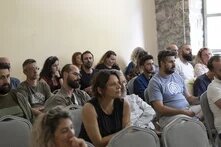
The dense programme of this four-day event included participatory workshops, discussions and presentations focusing on the present, the challenges, as well as the prospects of SSE initiatives and ecosystems. The aim was, on the one hand, to foster networking, empowerment and coordination among initiatives and experts in the SSE sector and, on the other, to connect, highlight and strengthen the Karditsa region –and particularly the Municipality of Lake Plastiras– within the broader work of the Heinrich Böll Foundation on the urban-rural divide.
Through the exchange of ideas and practices, the presentation of strategic proposals and the planning of tangible experiments, the need for new political narratives and strategies at the local level became even more evident.

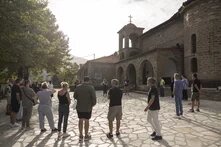
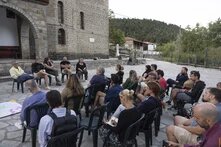
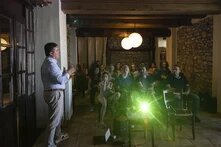
The “Academy of Alternatives” opened on the afternoon of Thursday, 11 September, in the village of Fylakti, specifically in the old school building, which –empty of students for years– now operates as a folklore museum and event space. There, a discussion entitled “From Crises to New Political Narratives” took place, setting the broader political framework within which all the individual activities of the event would unfold.
As was noted in the introduction, over the past decade Greek society has been experiencing a web of multiple crises –the economic crisis, the energy crisis, the cost-of-living crisis, the housing crisis, the crisis of democracy, the climate crisis and the care crisis– which are neither temporary nor independent of one another. On the contrary, they reinforce one another and reveal the deep shortcomings of the dominant model. At the same time, however, under certain conditions, crisis can also become a starting point for systemic change, new political directions and alternative narratives.
Through the participatory discussion, became clear the need for people involved in the SSE to get to know each other and collaborate; to demonstrate and receive solidarity and support; to move towards concrete action; and, also, to prioritise vision over difficulties and common ground over disagreements.
Empowering and coordinating SSE initiatives
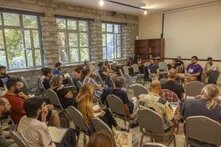
The first objective of the “Academy of Alternatives” –namely the networking, empowerment and coordination of initiatives and experts in the field of the Social Solidarity Economy (SSE)– was primarily pursued through the morning sessions of Friday, 12 September, and Saturday, 13 September, which focused on the internal dynamics of SSE ecosystems and on the creation of new experiments.
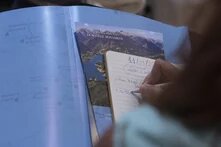
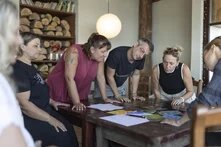
Thus, in the workshop “Collective narratives for the Social Solidarity Economy: A game with time,” coordinated by “Open Lab Athens” researcher Yannis Zgeras, participants were invited to draft three preliminary manifestos for cooperativism in Greece at three different moments: in the past, in the present and in the future. Through the collective writing of these texts, the political challenges faced by SSE initiatives were highlighted, while issues such as the relationship between cooperatives and the state, as well as the web of procedures and power relations shaping the historical trajectory of the cooperative movement, were examined.
Next, Ifigeneia Douvitsa, PhD in Cooperative Law from the School of Law, Democritus University of Thrace, led the workshop “Imagination as a collective tool: Co-creating open cooperatives,” first presenting the Heinrich Böll Foundation publication “Open, cooperative and flexible.” The book explores a new cooperative model, the so-called open cooperative, in which freelancers join forces by creating and using shared infrastructures based on new technologies and the logic of the digital commons, facilitating the management of everyday financial and other bureaucratic matters.
In the second part of the workshop, smaller groups worked on the experiential scenarios “Surviving in the countryside” and “Surviving in the city.” Through these exercises, participants sought to imagine cooperative initiatives emerging as responses to real dead ends –rural abandonment, overtourism, the commodification of neighbourhoods, the rising cost of living and the alienation of everyday life– activating the collective imagination and highlighting open cooperativism as a strategic tool for social change.
In another workshop, entitled “Sketching Strategic Pathways,” Giorgos Melissourgos, SSE Programme Coordinator at the Heinrich Böll Foundation, presented three distinct patterns of strategic thinking that do not remain at the level of theory, but are grounded in practice and in our lived experiences. Moving beyond the confines of the economy and broadening our perspective to include global movements, the workshop functioned both as a source of inspiration and as a collective experiment: strategic sketches that do not close things off, but instead open up possibilities we may not have previously considered.
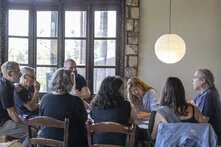
All of this also functioned as a prelude to the next workshop, “From Imagination to Practice: Co-designing Tangible Experiments,” with the same facilitator, which was directly linked to the strategic planning of the Heinrich Böll Foundation’s SSE programme for the years 2026-2027. More specifically, the Foundation’s plan for this period includes, among other things, support for tangible experiments to be proposed by formal and informal networks across five regions (Thessaloniki, Messinia, Karditsa, Epirus and Attica). The workshop thus constituted a crucial preparatory step in this direction, as its aim was the collective generation of original ideas and their translation into strategic pathways for action. Participants were grouped by local ecosystem and invited to co-develop experiments responding to social needs that are not met or are poorly addressed, as well as to map out concrete steps for their implementation up to 2030, effectively serving as a “rehearsal” for the actual proposals they are expected to submit.
Finally, through the short but substantial presentation of non-formal education trainer, Olympia Datsi, the highly useful workshop “Mapping Diverse Funding Pathways” focused on the ways in which cooperatives, collectives and SSE organisations can secure the necessary resources for their operation and development. Part of this workshop also included a presentation of the Cooperative Bank of Karditsa by its CEO, Panagiotis Tournavitis. The bank places particular emphasis on small businesses, farmers and individuals who are often not adequately served by larger financial institutions, implementing microfinance schemes and specialised social entrepreneurship programmes, and thereby helping shape the funding landscape of the social economy in Greece.
Connecting and highlighting the Karditsa Region
The second objective of the “Academy of Alternatives”, namely the connection, visibility and empowerment of the Karditsa region, and in particular the Municipality of Lake Plastiras, was explored mainly during the afternoon sessions, which were also open to the local community. Some of these, moreover, were part of a broader framework of political education, focusing on the current situation.
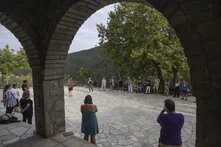
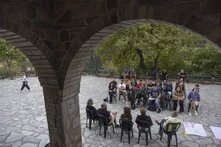
A characteristic example was the discussion held on Friday, 12 September, entitled “What Do We Do After Growth or If It Never Comes?”, which sought to propose an alternative narrative to the model that prioritises endless economic expansion. The square of Fylakti, a beautiful but weakened village where development, in its current sense, has never truly arrived, provided the ideal setting for this discussion. There, care was discussed not as an individual responsibility but as a collective infrastructure; energy communities not as a means of saving money but as a tool of local empowerment; the commons not as theory but as practice; and local communities not as recipients of “top-down” solutions, but as entities that collectively build their future.
“Within the framework of degrowth, what we seek is a good, autonomous life outside the logic of consumerism, without harming the community or the environment,” said Christos Giotitsas, researcher and member of the research collective “P2P Lab”. “It is not difficult for communities to take part in decision-making processes, but this must happen in the way they want,” said Elena Tzamouranou, who is mainly active in the region of Messinia as a member of “Villages in Action”. “We need a new reformist utopia, that involves reducing working time, ensuring universal basic services and strengthening self-organisation,” proposed Sofia Adam, Assistant Professor in the Department of Social Policy at Democritus University of Thrace. Finally, Costis Hadjimichalis, Professor Emeritus in the Department of Geography at Harokopio University, pointed out that “the development model we seek must also incorporate public health issues; otherwise, it will be undermined — as initiatives must address all real needs.” The discussion was moderated by Varvara Angeli, journalist at the cooperative media outlet “Typos-i” (www.typos-i.gr), based in Ioannina.
More specifically focused on the local level was the discussion of the following day, entitled “Synergies between Local Government and Cooperative Ecosystems,” which examined how local government could shift from being a passive implementer of national strategies to becoming an institution that co-constructs policies and implementable measures together with communities, and what role cooperative ecosystems can play in this direction.
The Mayor of Lake Plastiras, Panagiotis Nanos, presented the programme “Return to the Homeland,” a policy proposal for the repopulation of the area based on four pillars: 1. Allocation of cultivable land through a “land bank,” 2. Grafting wild chestnut trees and converting them into a cooperative chestnut grove, 3. Leveraging the cultural added value of the Open-Air Museum of Contemporary Art, 4. Provision of free business premises for start-up enterprises. At the same time, initiatives are being planned to address housing, both in terms of social housing and housing rehabilitation. For his part, Giorgos Gritzas, Professor in the School of Spatial Planning and Development Engineering at Aristotle University of Thessaloniki, presented two successful international examples of local partnerships between cooperative ecosystems and municipalities (Cleveland, USA, and Preston, UK). Valuable experience from the field of local government, particularly regarding the legal framework governing cooperation between SSE actors and local authorities, was shared by Chrysavgi Seggi, a staff member of Development Agency of Karditsa SA (ANKA SA). Finally, the perspective from the field was represented by Thaleia Pantoula, member of the social cooperative enterprise “Ta Psila Vouna” (means: “The High Mountains”), who referred to her personal experience of working with local government, which was not entirely negative, concluding that it is important for municipal administrative staff to possess training and expertise, and for political leadership to demonstrate will and vision.
The practical dimension of this cooperation between municipalities and SSE actors was highlighted in the workshop “Grafting the Innovation Hub of the Municipality of Lake Plastiras,” coordinated by Giorgos Bellis from Social Hub “Komvos”, a support organisation for cooperative initiatives active in the Karditsa region. The Social Hub “Komvos” is in fact the body supporting the “Innovation Hub of Lake Plastiras”, a space that will host the municipality’s vision for accommodating, empowering and connecting socially innovative initiatives and organisations. The workshop identified five key thematic axes from the municipality’s overall policy and further developed them with new elements, ideas and perspectives. Specifically, the five themes were: the organisation of informational and scientific events, the creation of a vocational training space, the operation of a shared technical workshop, the provision of free business premises, and the cooperative production of agricultural products. The interesting ideas that emerged became the subject of further elaboration in another workshop, organised by Social Hub “Komvos” a few days later, paving the way for the next steps.
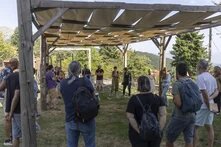
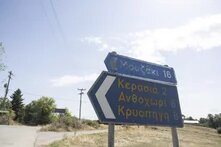
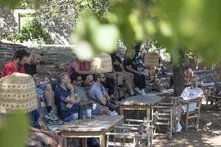
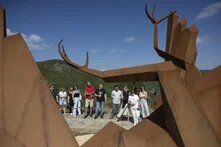
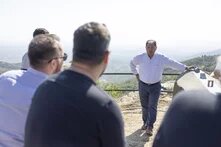
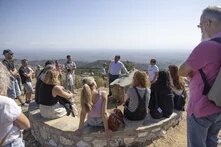
The “Academy of Alternatives” concluded on Sunday, 14 September, with a guided tour of the Open-Air Museum of Contemporary Art in Morfovouni, led by the Mayor of Lake Plastiras, Panagiotis Nanos. Beyond offering the participants of the Academy an encounter with art in an unexpected setting, the tour enabled them to become acquainted with the distinctive landscape, as well as with the rich past of the Agrafa region, providing them with an important sense of place, essential for any initiative and strategy addressed at the local level.